In multilevel analyses, it is often necessary to estimate a standardised mean difference (SMD) where the numerator is a covariate-adjusted mean difference and the denominator is the SD from a model without covariate adjustment.
I’m aware of two (frequentist, non-bootstrap) packages calculating an SMD and confidence interval in R. Here’s a comparison of them for simulated data.
Tag: policy evaluation
Work in progress – different ways to calculate Hedges’ g in cluster RCTs
The problem is, you want to estimate g with a covariate-adjusted treatment effect in the numerator but unadjusted SD in the denominator and an uncertainty interval of some description.
Work in progress R code here – scroll to the bottom for a table comparing results. Use at own risk.
Here is also a comparison of {eefAnalytics} and {lmeInfo}.
Difference-in-differences resources, by Jonathan Roth
“I have done a lot of work on difference-in-differences (DiD), and have tried to make as many resources as possible available online. This page collects links to those resources.”
“Enforce stricter standards on evaluation” – one of IfG’s 20 recommendations for improving the Civil Service
“A lack of robust evaluation of policies has long been a weakness of Whitehall policy making. But recent years have seen the establishment of the Evaluation Task Force, and more recently the Evaluation Registry. In a welcome move, it is now mandatory for all government evaluations to be published on the registry.
“These changes are young and therefore politically vulnerable. The new government should make an early commitment to safeguard this progress, and ensure that published evaluations are used as effectively as possible. This progress should also be built upon with firm standards for departments to meet regarding evaluation of key programmes.”
Is it a sensitivity analysis? (Morris, Kahan, & White, 2014)
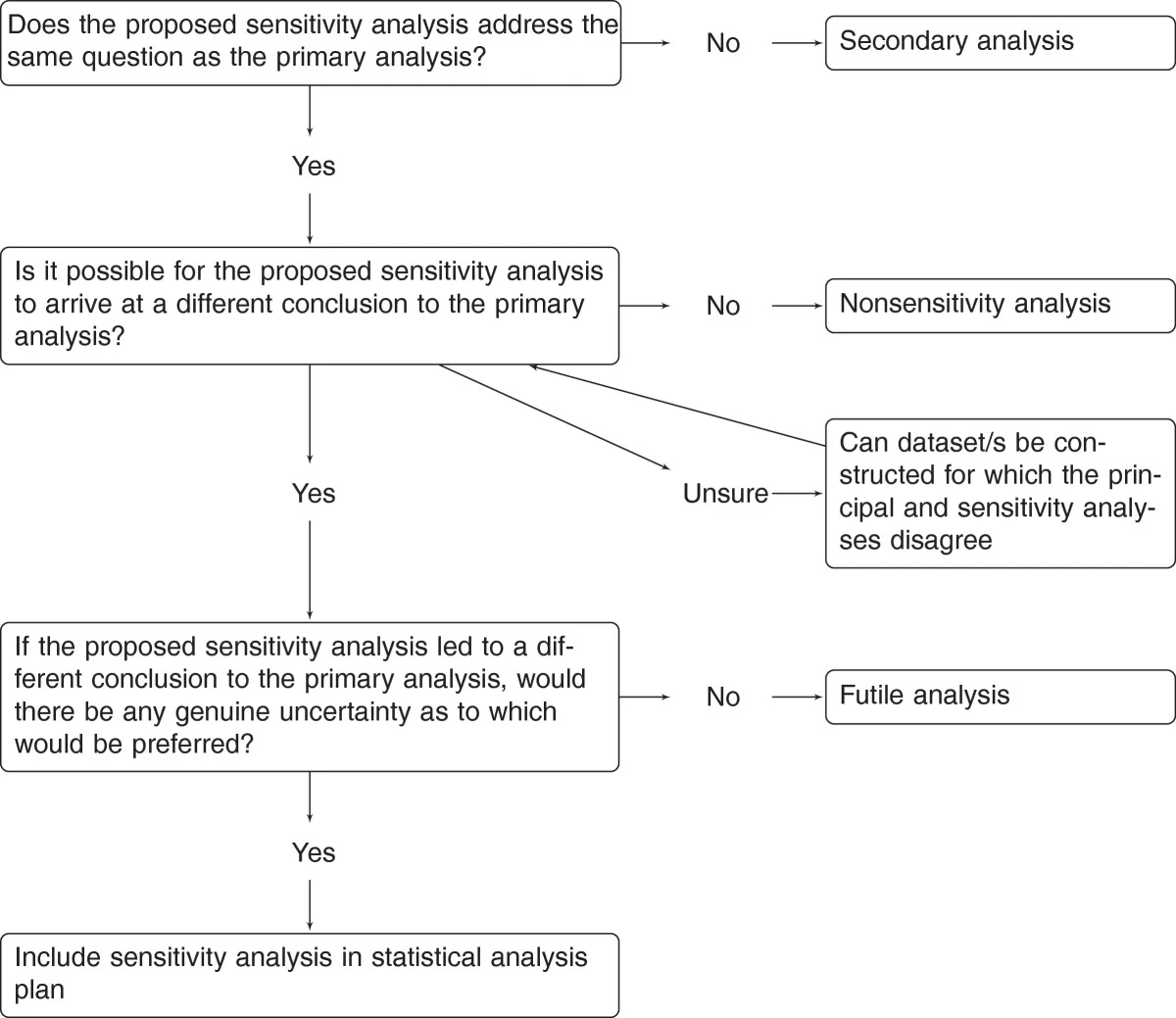
Morris, T.P., Kahan, B.C., & White, I.R. (2014). Choosing sensitivity analyses for randomised trials: principles. BMC Med Res Methodol, 14, 11.
Dipping into How to Think Like a Realist

Raw Pawson’s new book (Pawson, 2024) is an introduction to scientific practice, with social science as a corollary, drawing on the philosophy of science and Pawson’s experience conducting applied research. The book is on my reading stack. For now, I have taken a purposive sample of a few episodes (as Pawson calls the chapters) to get a sense of what’s in store. Here are some clues.
The main objective of the book (p. xvi)
“… is revealed in the structure of the text, which journeys across physical science and clinical science, before landing squarely in social science. The coverage here represents a commitment to the ‘unity of science’ (Oppenheim and Putnam, 1958). This heroic proposition claims that there are core explanatory principles which underpin science in all it guises, and the book makes tiny, tentative steps in tracing the common realist tenets. Perforce, I am also committed to the ‘unity of social science’.”
What about those context, mechanism, outcome triads that realist evaluators use? (p. 42)
“All scientific investigation utilises explanations relating mechanisms and contexts to empirical patterns.”
And (p. 48):
“With Harré, I have characterised generative causation in physical science as the analysis of mechanisms, contexts, and regularities (MCR). In clinical research the focus, quite properly, is on mechanisms, contexts, and outcomes (MCO). In social research, it might be wise to begin with the shorthand mechanisms, contexts, and change (MCC).”
(I wonder what the implications of the book are for realist evaluation as a distinct genre – will read those bits with interest.)
On social science and people who don’t follow science (p. xviii):
“Despite the habitual use of the appellation ‘social science’, many of my colleagues would reject any claim to follow science, dismiss any interest in causality, deny any need for objectivity, and scorn the possibility of generalisation. They are beyond hope. I don’t seek to convert them. But in following their chosen paths these various tribes – constructivists, post-modernists, emancipators, critics, essayists, relativists, and so on – have found time to say why causality, objectivity, and generality are false idols. So, in defending the science in social science, their criticisms also need to be overturned.”
More on what Pawson aims to do (pp. 251-252):
“What I’ve come up with here might well be entitled The Old Rules of Sociological Method. I have attempted to extract and justify some realist principles for conducting social research on the back of a generous portfolio of existing examples. Those illustrations reach across many research domains and a broad portfolio of practical methods. But they remain a pinprick; I could have called upon a thousand others. Accordingly, there is another way of perceiving my efforts. The book is no more and no less than an attempt to codify and formalise existing practices. I have tried to capture a tradition. So, just as Monsieur Jourdain spoke prose without knowing what it was, it may well be that you, dear reader, have been thinking like a realist without knowing it!”
I had to google Jourdain. He’s the main character in a comedy by Molière, Le Bourgeois gentilhomme (The Bourgeois Gentleman). The play satirises “the pretensions of the social climber whose affectations are absurd to everyone but himself”, which is a curious reference, dear reader.
References
Pawson, R. (2024). How to Think Like a realist: A methodology for social science. Edward Elgar Publishing Limited.
LaLonde (1986) after Nearly Four Decades: Lessons Learned (Guido Imbens, Yiqing Xu)
“We show that modern methods, when applied in contexts with significant covariate overlap, yield robust estimates for the adjusted differences between the treatment and control groups. However, this does not mean that these estimates are valid. To assess their credibility, validation exercises (such as placebo tests) are essential, whereas goodness of fit tests alone are inadequate. Our findings highlight the importance of closely examining the assignment process, carefully inspecting overlap, and conducting validation exercises when analyzing causal effects with nonexperimental data.”
Ioannidis and Psillos (2018) on mechanisms
“Mechanisms are causal pathways described in theoretical language that have certain functions; these descriptions can be enriched by offering more detailed or fine‐grained descriptions; the same mechanism can then be described at various levels using different theoretical vocabularies (e.g., cytological vs biochemical descriptions in the case of apoptosis); lastly, the descriptions of biomedically important mechanisms are often such that they contain specific causal information that can be used to make interventions for therapeutic purposes.” (Ioannidis & Psillos, 2018, pp. 1180–1)
Ioannidis, S., & Psillos, S. (2018). Mechanisms in practice: A methodological approach. Journal of Evaluation in Clinical Practice, 24(5), 1177–1183.
RCT of the ZOE nutrition app – and critical analysis
Abstract: “Large variability exists in people’s responses to foods. However, the efficacy of personalized dietary advice for health remains understudied. We compared a personalized dietary program (PDP) versus general advice (control) on cardiometabolic health using a randomized clinical trial. The PDP used food characteristics, individual postprandial glucose and triglyceride (TG) responses to foods, microbiomes and health history, to produce personalized food scores in an 18-week app-based program. The control group received standard care dietary advice (US Department of Agriculture Guidelines for Americans, 2020–2025) using online resources, check-ins, video lessons and a leaflet. Primary outcomes were serum low-density lipoprotein cholesterol and TG concentrations at baseline and at 18 weeks. Participants (n = 347), aged 41–70 years and generally representative of the average US population, were randomized to the PDP (n = 177) or control (n = 170). Intention-to-treat analysis (n = 347) between groups showed significant reduction in TGs (mean difference = −0.13 mmol l−1; log-transformed 95% confidence interval = −0.07 to −0.01, P = 0.016). Changes in low-density lipoprotein cholesterol were not significant. There were improvements in secondary outcomes, including body weight, waist circumference, HbA1c, diet quality and microbiome (beta-diversity) (P < 0.05), particularly in highly adherent PDP participants. However, blood pressure, insulin, glucose, C-peptide, apolipoprotein A1 and B, and postprandial TGs did not differ between groups. No serious intervention-related adverse events were reported. Following a personalized diet led to some improvements in cardiometabolic health compared to standard dietary advice. ClinicalTrials.gov registration: NCT05273268.”
Bermingham, K. M., Linenberg, I., Polidori, L., Asnicar, F., Arrè, A., Wolf, J., Badri, F., Bernard, H., Capdevila, J., Bulsiewicz, W. J., Gardner, C. D., Ordovas, J. M., Davies, R., Hadjigeorgiou, G., Hall, W. L., Delahanty, L. M., Valdes, A. M., Segata, N., Spector, T. D., & Berry, S. E. (2024). Effects of a personalized nutrition program on cardiometabolic health: A randomized controlled trial. Nature Medicine.
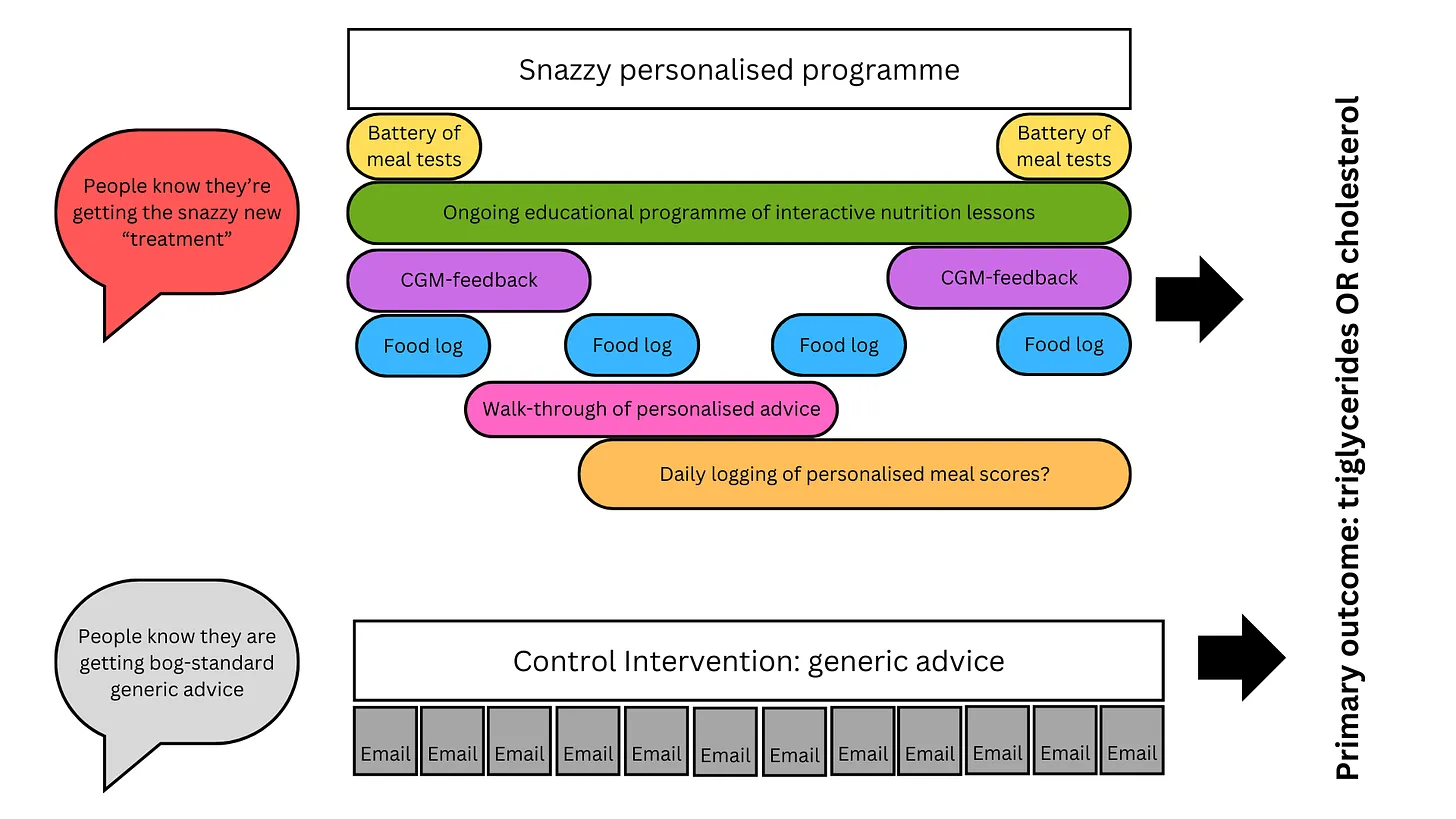
And here is a blog post that provides an in-depth critique. The key issue is the control group and how small a role the specific elements of Zoe plays, as illustrated in this pic:
Let’s not replace “impact evaluation” with “contribution analysis”

Giel Ton has written an interesting blog post arguing that we should shift from talking about “impact evaluation” to “contribution analysis”, in the form devised by Mayne. Ton defines contribution analysis as following this process:
“make a good theory of change, identify key assumptions in this theory of change, and focus M&E and research on these key assumptions.”
My first thought was, this definition is remarkably broad! It’s the same as for any theory-based approach (or theory-driven – evaluation is awash with synonyms) where you start with a theory of change (ToC) and test and refine it. See, e.g., what Fitz-Gibbon and Morris (1975), Chen and Rossi (1980), and many others were proposing before Mayne. They all criticise “black box” approaches that lob methods at a programme before stopping to think what it might do and how, so I wondered what makes Ton’s (and/or Mayne’s) proposal different to these broad umbrella approaches that include all methods, mixed, blended, interwoven, shaken, or stirred – so long as a ToC is used throughout.
One recurring issue is people endlessly rocking up with yet another panacea: “Behold! ACME Programme™ will finally sort out your social problem!” Effect size, 0.1 SDs, if you’re lucky. A piece by Thomas Delahais (2023) helped clarify for me what’s different about the contribution analysis approach and how it helps address the panacea phenomenon: alternative explanations of change are treated as being as important as the new programme being investigated. That’s a fun challenge, for all evaluation approaches, qual, quant and RCTs included. For instance, we would design statistical analyses to tell us something about mechanisms that are involved in a range of activities in and around a new programme. We would explore how a new programme interacts with existing activities. These ideas sound very sensible to me – and are often done through implementation and process evaluation. But taking seriously the broader context and alternative explanations of change is much broader than contribution analysis. We might call the activity something like “evaluation”.
References
Chen, H.-T., & Rossi, P. H. (1980). The Multi-Goal, Theory-Driven Approach to Evaluation: A Model Linking Basic and Applied Social Science. Social Forces, 59, 106–122.
Delahais, T. (2023). Contribution Analysis. LIEPP Methods Brief, 44.
Fitz-Gibbon, C. T., & Morris, L. L. (1975). Theory-based evaluation. Evaluation Comment, 5(1), 1–4. Reprinted in Fitz-Gibbon, C. T., & Morris, L. L. (1996). Theory-based evaluation. Evaluation Practice, 17(2), 177–184.