Telegram

There is lots of discussion about Telegram following Pavel Durov’s arrest. Three key intriguing bits of contextual info that often aren’t explained properly in reporting:

  • By default, end-to-end encryption (E2EE) isn’t switched on. It seems to be deliberately challenging to switch it on. E2EE, properly implemented, would mean that only sender and receiver can read a message and nobody in between, including Telegram (the company).
  • The E2EE approach Telegram uses has been assessed as “unusual” and only “quite possibly” secure by cryptographer Matthew Green.
  • It’s impossible to use E2EE on group chats, whether three participants or 3,000. So Telegram is potentially sitting on lots of interesting data.

See Matthew Green’s (25 Aug 2024) post.

It’s all a bit odd, given Durov’s professed desire to protect individual liberty and free speech. Matt Tait has previously (Dec 2022) explained how unique user IDs are sent in plain, even for E2EE messages, which Russian occupation forces in Ukraine used to spy on stay-behind operations.

BTW everyone goes on about how secure Signal is, but it held a database encryption key in plain on desktop installations until recently – unusual, given how riddled with vulnerabilities all our devices are. One would expect a secure messenger to prevent easy attacks if a device were compromised.
Russian Media Monitor (Julia Davis)

If you want a glimpse of how violent and disconnected from reality Russia’s national propaganda has become, check out Julia Davis’s Russian Media Monitor.

This (3 Jun 2024) clip of a popular show hosted by Vladimir Solovyov, featuring guests Andrey Gurulyov (member of the State Duma) and Andrey Bezrukov (also known as Donald Heathfield) among others, violently argues that Russia should start a nuclear war.

See also this BBC Monitoring report (29 April 2024).

Organising effective policy research teams – the case of INR

Interesting clues from the US State Department’s INR, according to this week’s report by Dylan Matthews:

  1. Most INR analysts have a PhD – some have professorships – and have worked on their topic area for an average of 14 years. There are few generalists.
  2. The organisation is relatively small and analyses tend to be written by individuals rather than large teams.
  3. Analysts work with State Department policymakers and so have a clearer understanding of what information is most useful to them.

Good summary of the XZ Utils supply chain attack, by Sigi Goode

“… some previously unknown accounts popped up to report bugs and submit feature requests to Collin, putting pressure on him to take on a helper in maintaining the project. Jia Tan was the logical candidate.

“Over the next two years, Jia Tan become more and more involved and, we now know, introduced a carefully hidden weapon into the software’s source code.

“The revised code secretly alters another piece of software, a ubiquitous network security tool called OpenSSH, so that it passes malicious code to a target system. As a result, a specific intruder will be able to run any code they like on the target machine.”

– Sigi Goode (4 April 2024). An anonymous coder nearly hacked a big chunk of the internet. How worried should we be?

What Russians think about the war against Ukraine

The Levada-Center has been asking Russians what they think about the war against Ukraine since the Russian escalation in February 2022. It is difficult to know what to make of findings, given the level of repression in Russia. Denis Volkov, Levada’s director, wrote a thoughtful piece on this question. A key section:

“… there is a thesis that in repressive Russian conditions, respondents will never say what they “really think.” But we never conduct surveys using a polygraph, and we only record what people are willing to share with the interviewer. Thus, pollsters get information not about people’s innermost thoughts, but about their public attitudes. However, this should be sufficient to understand and explain their behavior in public. One can hardly contest the fact that the pressure of the Russian state on the individual has recently increased. The main goal of such pressure is obviously to change people’s behavior, discouraging them from criticizing the authorities or participating in protests. And this works. But the results of the polls say exactly the same.”

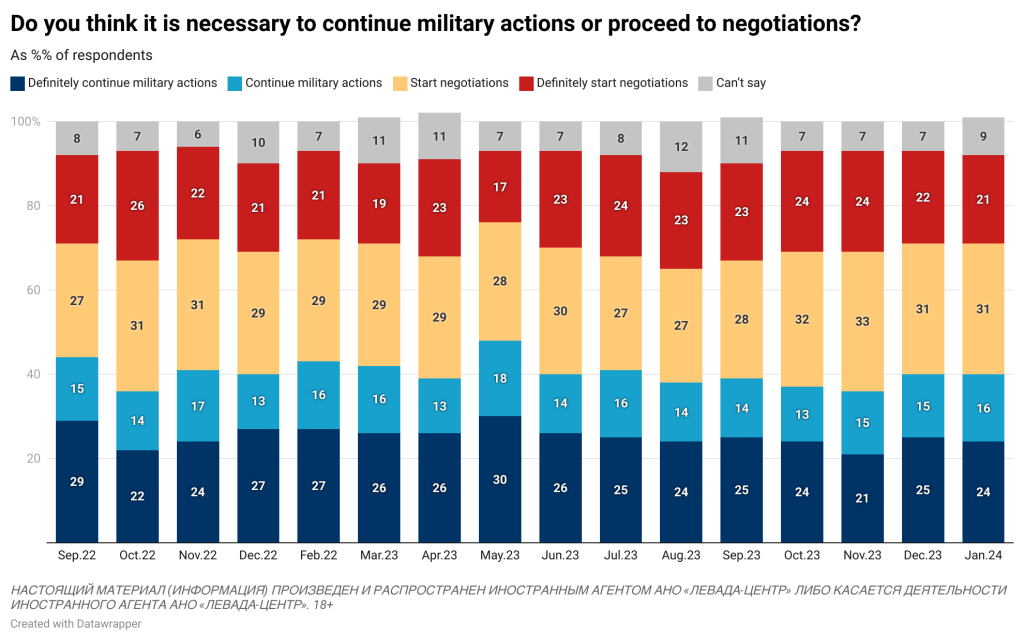
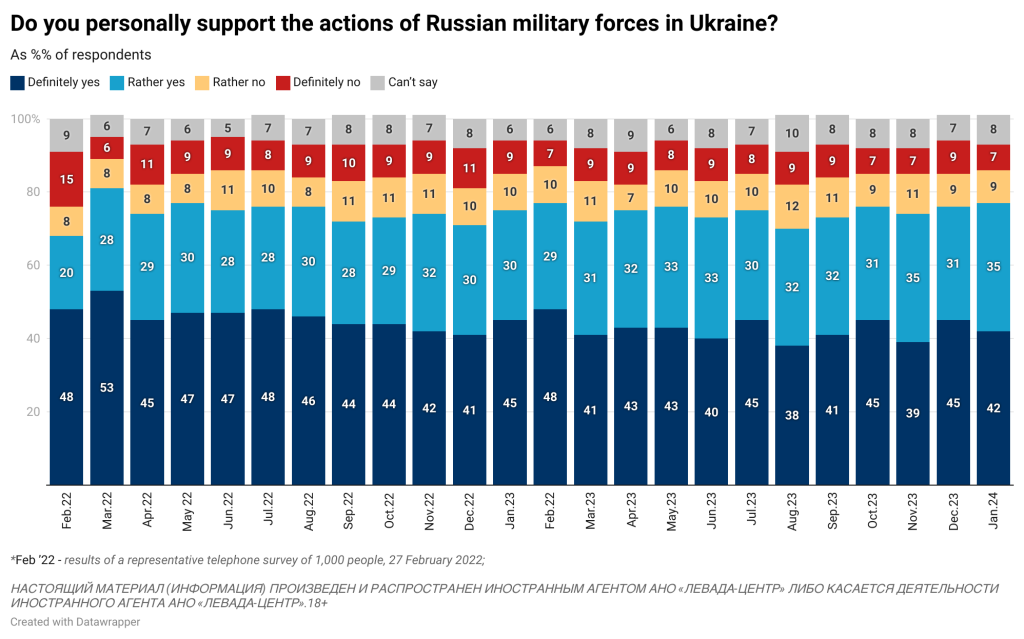
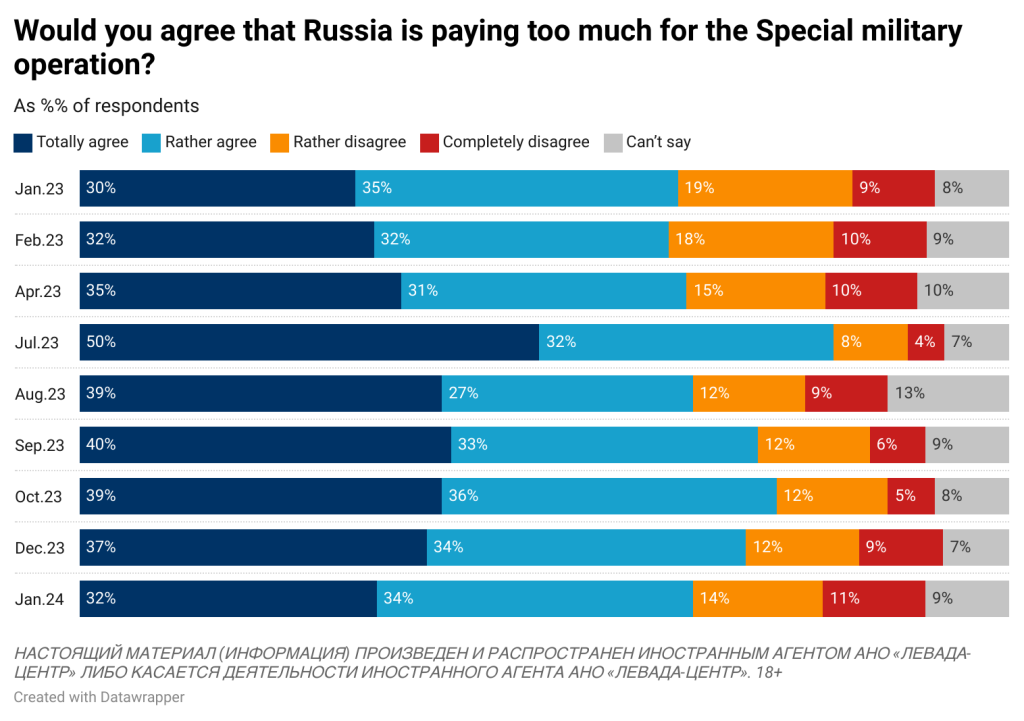
Looking at the most recent release (Wednesday 27th March 2024), three graphs caught my eye.

Firstly, most respondents say they personally support the actions of the Russian military in Ukraine, and this hasn’t changed a lot since the escalation began, hovering around 75%.

However, most people say that Russia is “paying too much” for the war. This peeked at 82% in July 2023. The most recent time point (Jan 2024) put it at 66%.

The final graph that caught my eye was how many people suggest proceeding to negotiations rather than continuing the military actions. That has been hovering around 50-50 in favour of negotiations versus war since the escalation.

There are other interesting findings concerning demographics, e.g., the older you are, the more likely you are to be following the war closely; younger people are less likely to support the military action; and people who get their news from YouTube rather than (presumably Russian) TV are less likely to support the war.

UK Google searches for “conscription”

There seems to be more press coverage suggesting that conscription will be likely in the UK in the coming years. This was seemingly prompted by Dutch Admiral Rob Bauer’s intervention on 17 Jan 2024, which was followed by other comments, e.g., by Gen Sir Patrick Sanders on 23rd, a flutter of comment on Gen Z’s apparent reluctance to go to war, and a YouGov poll.

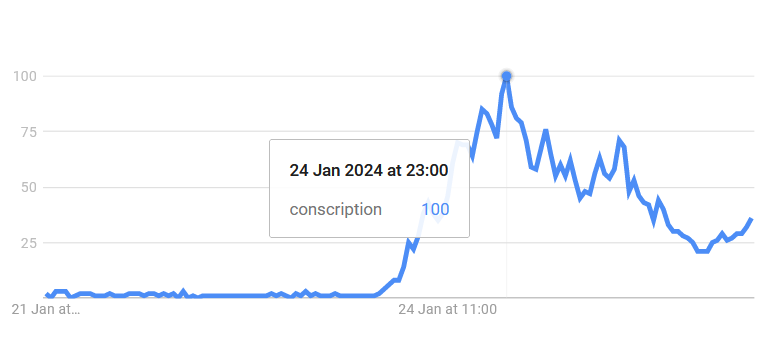
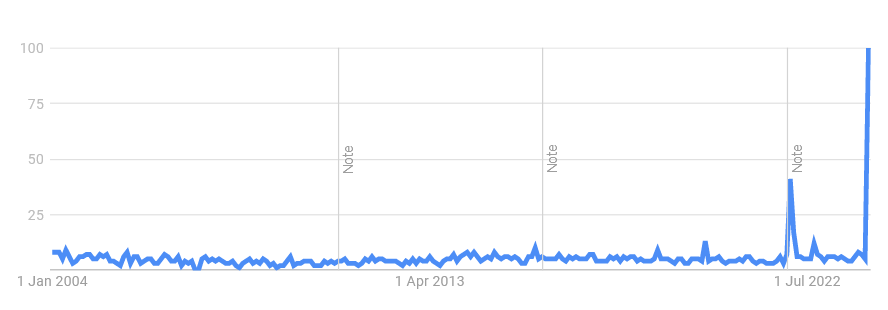
I was curious to discover what press coverage is doing to Google searches. Let’s have a look at Google Trends. First, zooming into the last seven days:

Searches began to pick up around 9pm on the 23rd, peaking 11pm on the 24th before fading out again:

Date Searches
2024-01-23T20 1
2024-01-23T21 2
2024-01-23T22 4
2024-01-23T23 6
2024-01-24T00 8
2024-01-24T01 8
2024-01-24T02 14
2024-01-24T03 25
2024-01-24T04 22
2024-01-24T05 28
2024-01-24T06 37
2024-01-24T07 43
2024-01-24T08 38
2024-01-24T09 35
2024-01-24T10 38
2024-01-24T11 46
2024-01-24T12 61
2024-01-24T13 71
2024-01-24T14 70
2024-01-24T15 69
2024-01-24T16 64
2024-01-24T17 75
2024-01-24T18 85
2024-01-24T19 82
2024-01-24T20 78
2024-01-24T21 72
2024-01-24T22 92
2024-01-24T23 100
2024-01-25T00 86
2024-01-25T01 81
2024-01-25T02 78
2024-01-25T03 71
2024-01-25T04 58
2024-01-25T05 57
2024-01-25T06 67
2024-01-25T07 75
2024-01-25T08 65
2024-01-25T09 55

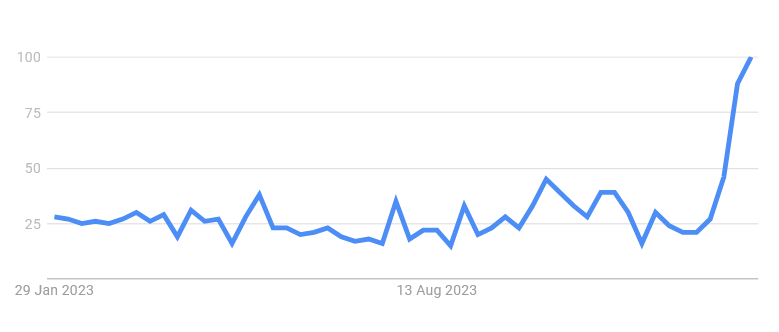
That’s a notably bigger increase than over the past year:

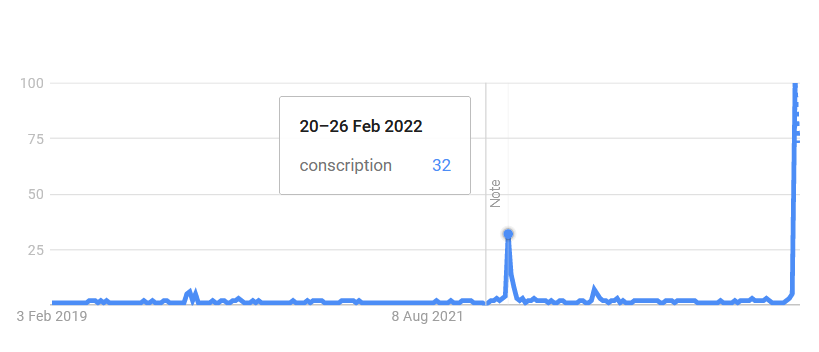
Zooming out, this year’s spike is more pronounced than one in Feb 2022, coinciding with Russia’s full-scale invasion of Ukraine on the 24th.

Here’s all the data:

(Corrected final two graphs on 4 Feb 2024 to take account of all data in Jan 2024.)

Defence and international affairs (Commons Library briefings)

Really useful selection of Commons Library research briefings for a general debate on defence and international affairs in the Commons Chamber on 24 January 2024.

Topics covered:

  • Middle East: Houthis, Yemen, Israel, Hamas, Occupied Palestinian Territories, Iran
  • Ukraine
  • Africa – notable how BIG Africa is and how few reports there are on it here
  • Asia: Taiwan and China
  • Defence: disruptive technologies, undersea infrastructure, parliamentary approval for military action
  • Armed forces
  • Arms exports
  • AUKUS submarine
  • Nuclear weapons, including the Iran nuclear deal and UK deterrent
  • International development, including aid spend reductions
  • International organisations: how the UN works and UK’s role
  • Rwanda
  • Pandemics
  • And finally: space!

Russian state disinformation campaigns

Two interesting reports:

European Commission, Directorate-General for Communications Networks, Content and Technology (2023). Digital Services Act: Application of the risk management framework to Russian disinformation campaigns. Publications Office of the European Union.

“During the first year of Russia’s illegal war in Ukraine, social media companies enabled the Kremlin to run a large-scale disinformation campaign targeting the European Union and its allies, reaching an aggregate audience of at least 165 million and generating at least 16 billion views. Preliminary analysis suggests that the reach and influence of Kremlin-backed accounts has grown further in the first half of 2023, driven in particular by the dismantling of Twitter’s safety standards.”

Microsoft Threat Analysis Center (2023). Russia’s African coup strategy.

“Today we are sharing a report from the Microsoft Threat Analysis Center (MTAC) on Russian influence operations in Africa, principally focused on the Niger coup. We believe it is vital there is wider understanding of the ways in which the internet is being used to stoke political instability around the world.”

“Silence was imperative…”

Peter Wright (1987, pp. 70-71) recounts the tale of a delicate MI5 operation to bug an embassy in London:

The house next door was temporarily empty, and A2 obtained access to install a series of microphones. Hugh Winterborn and I led a team of twelve officers from A Branch. Silence was imperative because we knew that the target premises were permanently manned near the party wall. I made a tremendous fuss insisting that everyone remove his shoes to avoid making noise on the bare floorboards. We worked nonstop for four hours in the freezing cold. All the floorboards on the first floor had been raised and I was patiently threading the cables along the void between the joists. After a time one of the leads became tangled on a split joist. Unable to clear the obstruction by hand, I began to ease myself down until one foot was resting on a masonry nail sticking out from one side of a joist. Just as I was inching toward the tangled cable, the nail gave way, and I plunged through the ceiling below. A large section of ceiling crashed fourteen feet to the floor below, reverberating around Portland Place like a wartime bomb. The noise and dust subsided, leaving me wedged tightly up to my waist in the hole in the ceiling. For a moment there was total silence.

“Good thing we removed our shoes,” quipped Winterborn dryly as laughter began to echo around the empty building.

– Peter Wright (1987, pp. 70-71), Spycatcher. Viking Penguin, Inc.