What should the is-ought thesis state?

Hume’s is-ought thesis states that we cannot infer a normative statement about what we should do from a descriptive statement about what is the case. This post spells out some of the detail about what the thesis means, which should be of interest to policy evaluators since we’re in the business of producing evidence and offering advice on policy that’s consistent with that evidence.

Let’s start with Prior’s (1960) puzzle (mildly edited): what kind of statement is “Either it’s raining or cricket should be banned”? It combines a descriptive statement (“it’s raining”) with a normative one (“cricket should be banned”), but is the disjunction of the two descriptive or normative?

Suppose Prior’s puzzle is a descriptive statement. Then by adding it to the premise “it’s not raining”, we can derive the purely normative conclusion that “cricket should be banned”. Since the disjunction is true, but one of its disjuncts is false, then the other disjunct must be true. We have just drawn an is-ought inference.

In symbols,

\(\displaystyle \neg R, R \lor \mathsf{O} B\ \models\ \mathsf{O} B\),

where \(R\) denotes “it’s raining”, \(\mathsf{O} B\) denotes that we ought to ban cricket (the \(\mathsf{O}\) is the “ought” from deontic logic), \(\lor\) is disjunction (or), \(\neg\) is negation, and \(\models\) is logical consequence.

This is maybe easier to see by rewriting the disjunction as a conditional, “If it’s not raining, then cricket should be banned” (since \(\neg \phi \lor \psi = \phi \rightarrow \psi\)):

\(\displaystyle \neg R, \neg R \rightarrow \mathsf{O} B\ \models\ \mathsf{O} B\),

where \(\rightarrow\) is the material conditional. The conclusion is then drawn by modus ponens. This pattern is interesting for evaluation, since it mirrors the logic:

  1. The programme works*.
  2. If the programme works*, we should roll it out nationally.
  3. Therefore, we should roll it out nationally.

Where works* includes a range of statements about impact and process evaluation evidence, whether that evidence can be generalised to a broader population, whether the programme avoids causing harm, its cost‑effectiveness, and other considerations.

In symbols,

\(\displaystyle W^*, W^* \rightarrow \mathsf{O} R\ \models\ \mathsf{O} R\),

where \(W^*\) denotes the programme works* and \(R\) denotes that we should roll it out.

Suppose instead that Prior’s puzzle is a normative statement. Starting from the purely descriptive premise “it’s raining”, we can infer “Either it’s raining or cricket should be banned” by disjunction introduction. Again, we have drawn an is-ought inference.

In symbols,

\(\displaystyle R\ \models\ R \lor \mathsf{O} B\).

Rewriting using implication,

\(\displaystyle R\ \models\ \neg R \rightarrow \mathsf{O} B\),

the conclusion is one of the “paradoxes” of the material conditional: true under classical logic because the antecedent is false, but people tend to judge the conditional to be neither true nor false but irrelevant (Johnson-Laird & Tagart, 1969).

The solution is, “Either it’s raining or cricket should be banned” is neither descriptive nor normative: it’s mixed. The same applies to “If the programme works*, we should roll it out nationally”. Three refinements of the is-ought thesis are provided in a logic-heavy book by Schurz (1997), which has been on my reading stack for years. A more digestible summary is provided by Schurz (2014, pp. 2–3):

(H1) No non-logically true purely normative conclusion can be derived from a consistent set of purely descriptive premises.

(H2) Every mixed conclusion [i.e., combining descriptive and normative statements] which follows logically from a set of purely descriptive premises is normatively irrelevant in the sense that all of its normative subformulas are replaceable by other arbitrary subformulas, while preserving the validity of the inference [“salva validitate of the inference” in Schurz’s original].

(H3) No non-tautologous descriptive statement can be inferred from a consistent set of purely normative premises.

H1 is the thesis that applies most to evaluation: to make an evaluative judgement, you need mixed premises that blend normative and descriptive statements. H2 deals with weird uses of logic. I’ve used the principle of irrelevance it contains to help understand how people reason about sentences like “If Alex posted the letter, then he posted the letter or set fire to the letter”, which are true in classical logic but which people often judge to be false (Fugard et al., 2011). There’s a blog post about it yonder. H3 says that knowing or believing what should be true doesn’t tell you what is factually true.

There is, however, a well‑known problem with using the material conditional in combination with oughts (Chisholm, 1963), e.g., \(W^* \rightarrow \mathsf{O} R\) used above. Consider the following sentences and formalisations:

  1. It ought to be that Jones goes to assist his neighbours: \(\mathsf{O} g\).
  2. It ought to be that if Jones goes, then he tells them he is coming: \(\mathsf{O} (g \rightarrow t)\).
  3. If Jones doesn’t go, then he ought not tell them he is coming. \(\neg g \rightarrow \mathsf{O} \neg t\).
  4. Jones doesn’t go: \(\neg g\).

The English‑language statements feel consistent with each other. They are also independent in the sense that no one sentence follows from any of the others. A formalisation should preserve both features.

There are three paths through, using what has come to be known as standard deontic logic (SDL). McNamara and Van De Putte (2025, Section 2.1) provides an introduction to SDL. Section 4.1 provides the illustration of Chisholm’s (1963) problem, which I’ve just spelt out a little. Here’s a summary of the paths:

Path APath BPath C
(1′) \(\mathsf{O}g\)
(2′) \(\mathsf{O}(g \rightarrow t)\)
(3′) \(\neg g \rightarrow \mathsf{O}\neg t\)
(4′) \(\neg g\)
(1′) \(\mathsf{O}g\)
(2′) \(\mathsf{O}(g \rightarrow t)\)
(3″) \(\mathsf{O}(\neg g \rightarrow \neg t)\)
(4′) \(\neg g\)
(1′) \(\mathsf{O}g\)
(2″) \(g \rightarrow \mathsf{O}t\)
(3′) \(\neg g \rightarrow \mathsf{O}\neg t\)
(4′) \(\neg g\)
From (1′), (2′), \(\mathsf{O}t\).
From (3′), (4′), \(\mathsf{O}\neg t\).
Consistency is lost.
(1′) implies (3″).
Independence is lost.
(4′) implies (2″).
Independence is lost.

Following Path A, we deduce that Jones ought to tell them he is coming and ought not tell them he is coming, which is suspect. This uses the following SDL rule:

\(\mathsf{O}(\varphi \rightarrow \psi) \rightarrow (\mathsf{O}\varphi \rightarrow \mathsf{O}\psi)\text{,} \tag{OB-K}\)

which gives us \(\mathsf{O}g \rightarrow \mathsf{O} t\) (from 2′). This (alongside 1′) gives us \(\mathsf{O}t\) by modus ponens. We can also get \(\mathsf{O}\neg t\) using modus ponens (3′ and 4′). It also contradicts one of the axioms of SDL: if you should do something, then you shouldn’t also do the negation of that something:

\(\mathsf{O} \phi \rightarrow \neg \mathsf{O}\neg \phi \tag{NC}\)

Paths B and C attempt to use the same expression for the conditional oughts in sentences 2 and 3. Path B uses

\(\mathsf{O}(\phi \rightarrow \psi)\).

Path C uses

\(\phi \rightarrow \mathsf{O}\psi\),

which we encountered above when exploring Prior’s (1960) puzzle.

The problem with both attempts to save SDL is that the sentences become dependent, whereas in the original informal English they aren’t. For Path B, \(\mathsf{O}(\neg g \rightarrow \neg t)\) is vacuously true (when rewritten using OB-K) because \(\mathsf{O}g\) is true – a paradox of the material conditional again. Similarly for Path C, \(g \rightarrow \mathsf{O}t\) is vacuously true because \(\neg g\) is.

So however we choose to formalise the sentence “if you should do A, then you should do B” or “if A, then you should do B”, it is not something that can be captured within SDL – a conclusion reached in the late 1960s (Parent & Torre, 2018, p. 20). This conclusion is familiar from work in the psychology of reasoning, where the material conditional is replaced with systems that behave more like everyday inference.

One approach uses defeasible logics, which allow us to retract a conclusion when new information arrives and to treat some premises as having greater priority than others (e.g., Neves et al., 2002). Another approach uses probability logics, which model reasoning under uncertainty (e.g., Pfeifer & Kleiter, 2009). Probability logics typically rely on an underlying three‑valued semantics, in which a statement can be true, false, or neither. The third value is usually interpreted as something like “irrelevant” or “undetermined”.

A recent review of deontic logic (McNamara & Van De Putte, 2025) concludes that “there are a number of outstanding problems for deontic logic. Some see this as a serious defect; others see it merely as a serious challenge, even an attractive one.” I’ve been reading attempts to solve some of these problems, e.g., Horty (2012), which applies defeasible logic to deontic reasoning. See the follow-up.

References

Chisholm, R. M. (1963). Contrary-to-duty imperatives and deontic logic. Analysis, 24, 33–36.

Fugard, A., Pfeifer, N., & Mayerhofer, B. (2011). Probabilistic theories of reasoning need pragmatics too: modulating relevance in uncertain conditionals. Journal of Pragmatics, 43, 2034–2042.

Horty, J. F. (2012). Reasons as defaults. Oxford University Press.

Johnson-Laird, P., & Tagart, J. (1969). How implication is understood. The American Journal of Psychology, 82, 367–373.

McNamara, P., & Van De Putte, F. (2025). Deontic logic. In E. N. Zalta & U. Nodelman (Eds), The Stanford encyclopedia of philosophy (Winter 2025). Metaphysics Research Lab, Stanford University.

Neves, R. D. S., Bonnefon, J.-F., & Raufaste, E. (2002). An Empirical Test of Patterns for Nonmonotonic Inference. Annals of Mathematics and Artificial Intelligence, 34, 107–130.

Parent, X., & Torre, L. van der. (2018). Introduction to Deontic Logic  and Normative Systems. College Publications.

Pfeifer, N., & Kleiter, G. D. (2009). Framing human inference by coherence based probability logic. Journal of Applied Logic, 7, 206–217.

Prior, A. N. (1960). The autonomy of ethics. Australasian Journal of Philosophy, 38(3), 199–206.

Schurz, G. (1997). The Is-Ought Problem: An Investigation in Philosophical Logic. Springer.

Schurz, G. (2014). Cognitive success: Instrumental justifications of normative systems of reasoning. Frontiers in Psychology, 5(625).
Two fun R packages

Pinference: Probability Inference for Propositional Logic. “Implementation of T. Hailperin’s procedure to calculate lower and upper bounds of the probability for a propositional-logic expression, given equality and inequality constraints on the probabilities for other expressions. Truth-valuation is included as a special case. Applications range from decision-making and probabilistic reasoning, to pedagogical for probability and logic courses.”

RobinCar2: ROBust INference for Covariate Adjustment in Randomized Clinical Trials. “Performs robust estimation and inference when using covariate adjustment and/or covariate-adaptive randomization in randomized controlled trials.” Though see this post.

Logic and psychology

I happened upon an interesting question on Philosophy Stack Exchange: “What are the main views among academics on the question of the relation between logic and human cognition?” Here follows (a lightly edited version of) my answer.

Van Benthem (2008) offers examples of how cognition and social practices influence the development of logics, citing, e.g., Prior’s work on temporal structures and Lewis and Stalnaker on comparative orderings of possible worlds. He concedes that much of the work in this direction is informal (p. 74):

Logicians analyzing natural language, or computer scientists modeling “common sense”, tend to go by their own intuitions, anecdotal evidence from colleagues, email surveys of sometimes surprising naiveness, and other easy procedures that avoid the laboratories and statistical packages of the world of careful experimental design. But even so, experimental evidence is relevant, in that these theories can be, and sometimes are, modified under pressure of evidence from actual usage, even when it comes through these home-grown sources.

He also points to work in the other direction, where cognitive scientists take non-classical logics and use them to model social and cognitive phenomena. An example I know about (it was one of the reasons I chose my PhD topic and supervisor) is Stenning and van Lambalgen’s (2005) analysis of the “suppression task” in psychology, using nonmonotonic logic. Probability theory may be viewed as a kind of logic and it is used in cognitive science too; try e.g., Pfeifer (2013) and references that follow.

One key element of cognitive science studies that use logics is how people interpret tasks, and often have different interpretations, which can be modelled as choosing a logic and setting its parameters. Geis and Zwicky (1971) observe that logic students sometimes map the natural language indicative “if A, then B” to a biconditional in classical logic, so even in logic class interpretations aren’t naive.

Cognitive scientists don’t expect non-specialists to be aware of the logics that model their interpretations and inferences, e.g., here’s Da Silva Neves, Bonnefon, and Raufaste (2002, p. 110) discussing the relationship between potential properties of people’s reasoning systems and how people feel that they reason:

… even if we expect human inference to corroborate these properties, we know of no sufficient reason to think that lay reasoners would recognize any rationality postulate as valid, neither that they would conscientiously use them to guide their reasoning. […W]e assume that human inference is constrained by knowledge organisation in memory and that its formal properties emerge from a spreading activation process operating directly on knowledge structures.

References

van Benthem, J. (2008). Logic and reasoning: Do the facts matter? Studia logica, 88, 67-84.

Da Silva Neves, R., Bonnefon, J. F., & Raufaste, E. (2002). An empirical test of patterns for nonmonotonic inference. Annals of Mathematics and Artificial Intelligence, 34, 107-130.

Geis, M. L., & Zwicky, A. M. (1971). On invited inferences. Linguistic inquiry, 2(4), 561-566.

Pfeifer, N. (2013). The new psychology of reasoning: A mental probability logical perspective. Thinking & Reasoning, 19(3-4), 329-345.

Stenning, K., & van Lambalgen, M. (2005). Semantic interpretation as computation in nonmonotonic logic: The real meaning of the suppression task. Cognitive Science, 29(6), 919-960.

Four ways to calculate the probability that if it rains, I have an umbrella

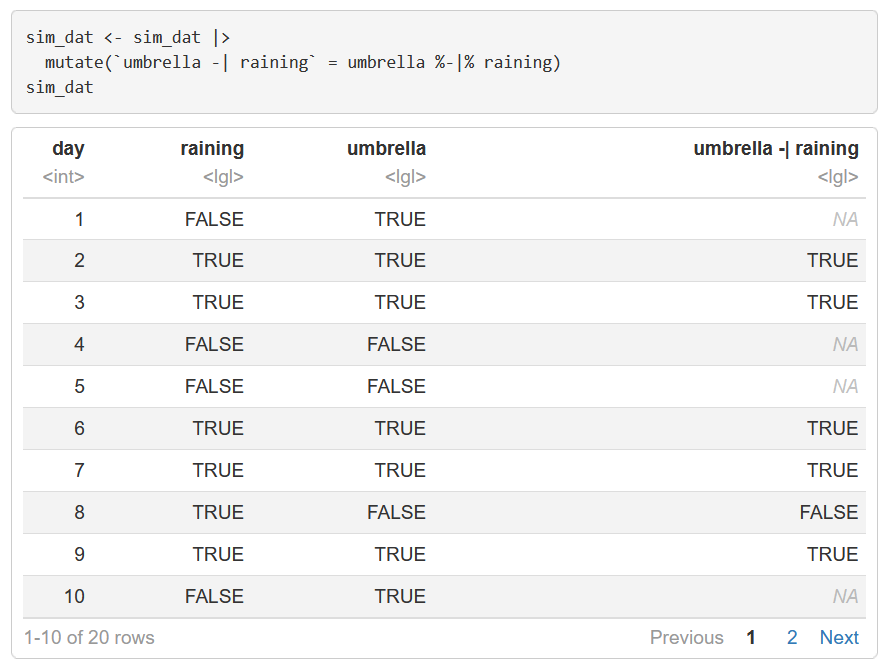
This post shows four ways to calculate the conditional probability that I have an umbrella, given that it’s raining, \(P(umbrella|raining)\). The first way uses the ratio formula, \(P(raining \land umbrella)/P(raining)\). The second uses a three-valued logical connective, the conditional event, which can be traced back to the work of Bruno de Finetti in the 1930s (see, e.g., Baratgin, 2021). The third filters the dataset to rows where it’s raining before counting the proportion of those where I had an umbrella. The fourth uses logistic regression.

On a relevance criterion

Logicians study logics – plural. There are different logics for different reasoning tasks. Classical logic, the flavour taught to undergraduate students of all persuasions, falls apart when confronted with the kinds of reasoning that people do effortlessly every day. My favourite way to break classical logic involves an innocent “if” and “or”.

Ponder the following sentence (based on an example by Alf Ross, 1944):

If Alex posted the letter [P], then Alex posted the letter [P] or Alex set fire to the letter [F].

If you think this sentence is true, then your interpretation and reasoning are compatible with translating it into classical logic using the material conditional (\(\Rightarrow\)) for the “if” and inclusive disjunction (\(\lor\)) for the “or”. You could write it like this and it’s trivially true: \(P \Rightarrow (P \lor F)\).

Some people are perfectly content with this interpretation, but many think the sentence is fishy and false.  There are a number of ways to explain what has happened.

One is to assume that the issue is language pragmatics rather than logic. Pragmatics studies the ways in which context and social conventions for communication affect people’s interpretation of language. According to one theory of communication (see Liza Verhoeven’s 2007 explanation), asserting that you posted the letter or burned it under the assumption that you posted it violates principles of cooperativeness. These principles affect the meaning of a sentence and its truth, so in this case the sentence is false.

Another way to make sense of what has gone wrong is using a relevance criterion devised by Gerhard Schurz (1991). The first step we need to take is to transform the “if” into an argument with a single premise and conclusion.

Premise: Alex posted the letter [P].
Conclusion: Alex posted the letter [P] or Alex set fire to the letter [F].

This is an uncontroversial step in classical logic, e.g., application of a rule for introducing an “if” in natural deduction.

Schurz introduces a criterion for a conclusion relevance that roughly goes as follows. The starting point is an argument that is valid according to classical logic. That’s the case for the argument above. If there are any terms in the conclusion that can be substituted with arbitrary alternatives without affecting the argument’s validity, then the conclusion is irrelevant. Otherwise the conclusion is relevant.

For our letter example, we can replace “Alex set fire to the letter” with anything and it has no effect on the validity of the argument. Alex opened the letter. Alex scribbled on the letter. Alex swallowed the letter. The letter was a surrealist painting. The letter was the size of house. And so on. No substitution in the second half of the conclusion can affect the validity of the argument, so the conclusion is irrelevant.

How about an argument where the conclusion is relevant? The trick is to ensure that everything in the conclusion is… relevant. That’s what I like about the criterion: it formalises an intuitive property of arguments. Here’s an easy example:

Premise: It’s raining and I left my umbrella at home
Conclusion: I left my umbrella at home and it’s raining

This is an example of the conjunction, “and”, being commutative in classical logic: the order of the conjuncts in the sentence (the parts on either side of “and”) doesn’t affect its truth. There are many ways to edit the conclusion so that the argument is no longer valid. For instance replace one or both of the conjuncts with “I posted a letter”. Then the conclusion doesn’t follow from the premise since the premise doesn’t tell us anything about a letter.

Colleagues and I explored people’s interpretations of these kinds of sentence about a decade ago in the context of an alleged paradigm shift in the psychology of reasoning. Read all about it. I was reminded of this again as Google Scholar dutifully notified me that Michał Sikorski recently cited it (thank you kindy Michał!).

Drawing an is-ought

Hume’s Treatise famously argued that we cannot infer an “ought” from an “is”. This has presented an enduring problem for science: how should we produce a set of recommendations for what should be done following the results of a study? If a new cancer treatment dramatically improves remission rates, should study authors simply shrug, present the results, and leave the recommendations to politicians? What if a treatment causes significant harms – can we recommend that the treatment be banned? Or suppose we have ideas for future studies that should be carried out and want to summarise them in the conclusions…?

The solution, if it is one, is that any recommendations require a set of premises stating our values. These values necessarily assert something beyond the evidence, for instance that if a treatment is effective then it should be provided by the health service. In practice, such values are often left implicit and assumed to be shared with readers. But there are interesting examples where it is apparently possible to draw an is-ought inference without assuming values.

One example, due to Mavrodes (1964), begins with the premise

If we ought to do A, then it is possible to do A.

This seems reasonable enough. It would, for instance, be horribly dystopian to require that people behave a particular way if it were impossible for them to do so. Games like chess and tennis have rules that are possible – if they were impossible then it would make playing the games challenging. Let’s see what happens if we apply a little logic to this premise.

Sentences of the form

If A, then B

are equivalent to those of the contrapositive form

If not-B, then not-A

This can be seen in the truth table below, where 1 denotes true and 0 denotes false. The values of the last two columns are equivalent:

A B not-A not-B If A, then B If not-B, then not-A
1 1 0 0 1 1
1 0 0 1 0 0
0 1 1 0 1 1
0 0 1 1 1 1

Together, this means that if we accept the premise

If we ought to do A, then it is possible to do A,

and the rules of classical logic, we must also accept

If it is not possible to do A, then it is not the case that we ought to do A.

But here we have an antecedent that is an “is” and a consequent that is an “ought”: logic has licenced an is-ought!

Worry not: there has been debate in the literature… See Gillian Russell (2021) for a recent analysis.

References

Mavrodes, G. I. (1964). “Is” and “Ought.” Analysis, 25(2), 42–44.

Russell, G. (2022). How to Prove Hume’s Law. Journal of Philosophical Logic, 51(3), 603–632.

A psychoanalyst walks into a bar(red subject)

A psychoanalyst walks into a bar with a book on logic and set theory. He orders a whisky. And another. Twelve hours and a lock-in later, all he has to show for the evening is a throbbing headache and some indecipherable rubbish scrawled on a napkin.

That’s the only conceivable explanation for these diagrams from The Subversion of the Subject and the Dialectic of Desire in the Freudian Unconscious, by Jacques Lacan (published in the Écrits collection):

But, surely this notation means something? After all, Lacan is famous and academics across the world dedicate their lives to understanding his genius.

Also the notation f(x) is a function, f, applied to argument x – that’s recognisable from maths. So the I(A) and s(A) must mean something…?

To illustrate how function notation is usually used, consider the Fibonacci sequence, which pops up in all kinds of interesting places in nature. It is defined as follows:

f(0) = 0,
f(1) = 1,
f(n) = f(n-1) + f(n-2), for n > 1.

In English, this says that the first two numbers in the sequence are 0 and 1 and the numbers following are obtained by summing the previous two. So the sequence goes: 0, 1, 1, 2, 3, 5, 8, 13, 21, 34, …

The function notation “does something”. It provides a way of defining and referring to (here, mathematical) concepts. I claim that the brief explanation above would make some kind of sense to most people who can add two numbers together.

Less well-known, but appearing in university philosophy courses, is the lozenge symbol, ◊, which means “possible” in a particular kind of logic called modal logic. So if R stands for “it’s raining” then ◊R stands for “it’s possible that it’s raining”. It seems plausible that there is something meaningful here in Lacan’s use of the symbol too.

Here is Lacan, “explaining” his notation to his almost entirely non-mathematical readership:

Huh?

Lacan doesn’t try to explain what the notation means; he doesn’t seem to want readers to understand. Maybe he is just too clever and if only we persevered we would get what he means. Elsewhere in the same text, Lacan uses arithmetic to argue that “the erectile organ can be equated with \(\sqrt{-1}\)”. I’m told this is a joke because \(\sqrt{-1}\) is an imaginary number. Maybe trainee psychoanalysts learn about complex numbers so get the joke. I doubt it though. Maybe all Lacanian discourse is dadaist performance – that at least would make some sense.

Alan Sokal and Jean Bricmont have written a book-length critique of Lacan’s maths and others’ similar misuse of natural science concepts. Having read lots of mathematical texts and seen how authors make an effort to introduce their notation, I think it’s entirely possible Lacan is a fraud, ◊(Lacan is a fraud). That might sound harsh, but forget how famous he is and just look at the pretentious rubbish he writes.

Prover9 and Mace4

Just found two fantastic programs and a GUI for exploring first-order classical models and also automated proof, Prover9 and Mace4.  There are many other theorem provers and model checkers out there.  This one is special as it comes as a self-contained and easy to use package for Windows and Macs.

There are many impressive examples built in which you can play with.  To start easy, I gave it a syllogism:

all B are A
no B are C

with existential presupposition, which is expressed:

exists x a(x).
exists x b(x).
exists x c(x).
all x (b(x) -> a(x)).
all x (b(x) -> -c(x)).

and asked it to find a model. Out popped a model with two individuals, named 0 and 1:

a(0).
- a(1).

b(0).
- b(1).

- c(0).
c(1).

So individual 0 is an A, a B, but not a C. Individual 1 is not an A, nor a B, but is a C.

Then I requested a counterexample to the conclusion no C are A:

a(0).
a(1).

b(0).
- b(1).

- c(0).
c(1).

The premises are true in this model, but the conclusion is false.

Finally, does the conclusion some A are not C follow from the premises?

2 (exists x b(x)) [assumption].
4 (all x (b(x) -> a(x))) [assumption].
5 (all x (b(x) -> -c(x))) [assumption].
6 (exists x (a(x) & -c(x))) [goal].
7 -a(x) | c(x). [deny(6)].
9 -b(x) | a(x). [clausify(4)].
10 -b(x) | -c(x). [clausify(5)].
11 b(c2). [clausify(2)].
12 c(x) | -b(x). [resolve(7,a,9,b)].
13 -c(c2). [resolve(10,a,11,a)].
16 c(c2). [resolve(12,b,11,a)].
17 $F. [resolve(16,a,13,a)].

Indeed it does. Unfortunately the proofs aren’t very pretty as everything is rewritten in normal forms.  One thing I want to play with is how non-classical logics may be embedded in this system.