Resignations

Interesting dataset from the Institute for Government. (I last updated this after Streeting resigned.)

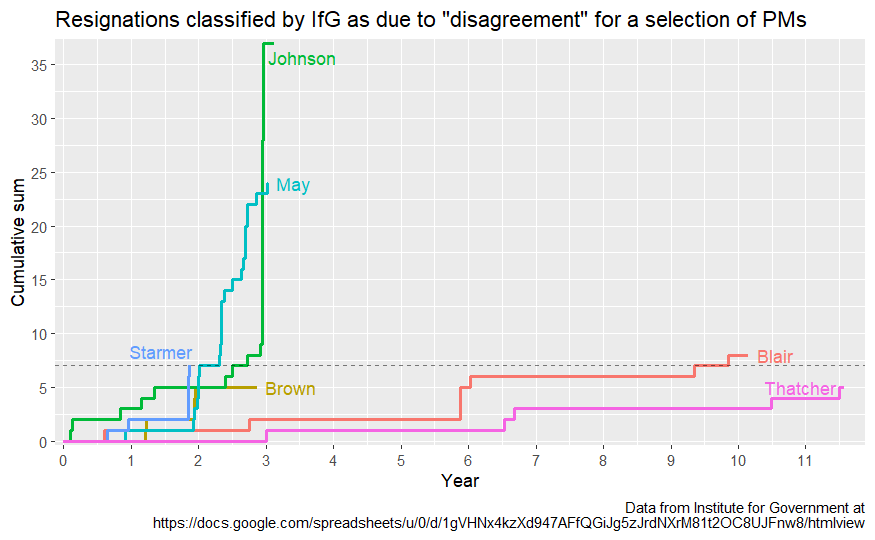
Here’s a cumulative count of resignations that were coded by IfG as being due to “disagreement”, for a selection of PMs. The dashed horizontal line shows Starmer’s count:

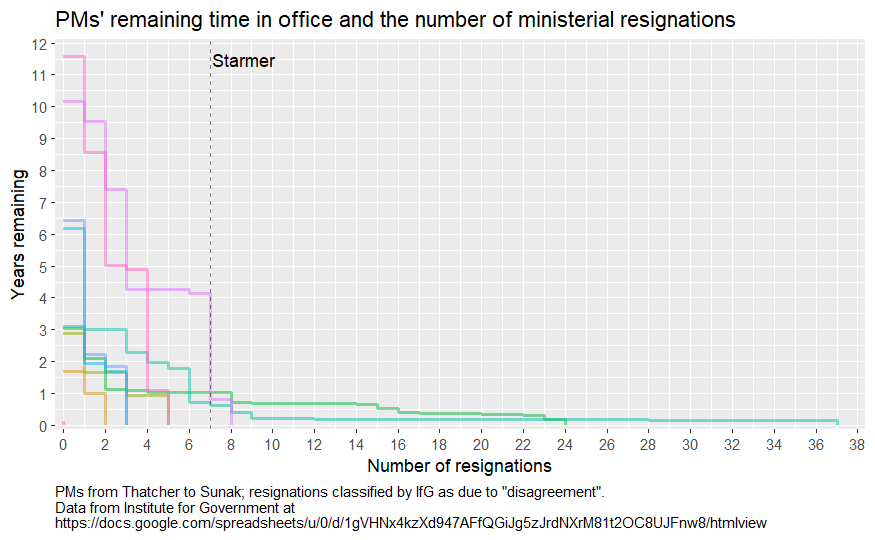
Expanding out to all PMs in the data (from Thatcher to Sunak), how long did they have left as the number of resignations grew? (Note: different colours – also remember the small number of PMs!)

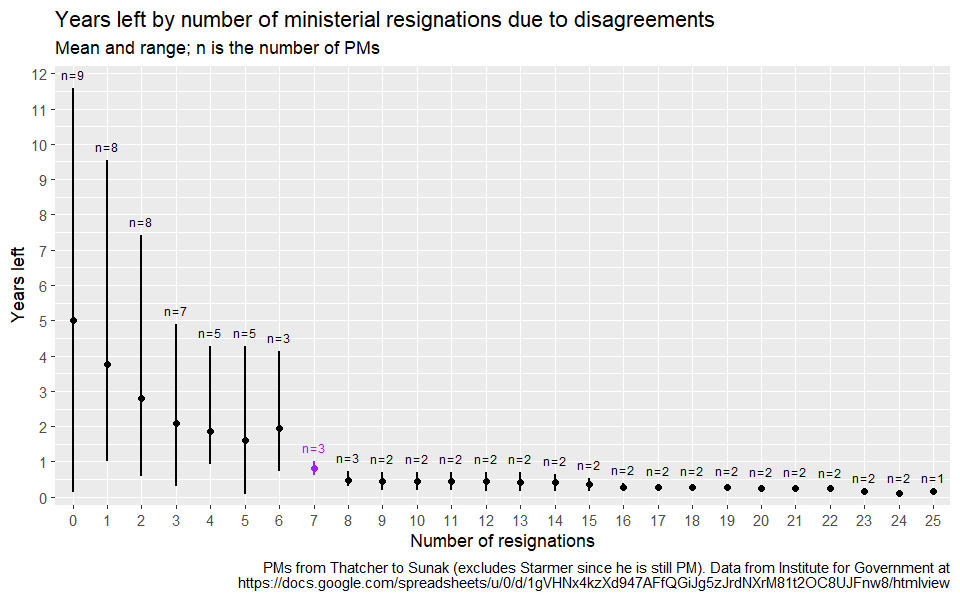
Another attempt to visualise (again, remember small n – the lines give a range not uncertainty!). Purple marks where Starmer is currently at, though the data excludes him since he’s still PM.

“It is not unheard of for permanent secretaries, in a sense, to try and work in a way which allows there to be a decision”

Edward Morello: Well, we should put on record that you have served under four different Prime Ministers. At any point during your tenure as perm sec, were you asked by a No. 10 organisation to withhold information from the Foreign Secretary? How usual is that request?

Sir Philip Barton: I am worried that everyone is going to think that the centre of Government spends its whole time sort of conniving behind the backs of everyone else in Government. That is not the reality. The reality is people trying to get on with delivering the business of the Government the vast majority of the time. My best answer to that question is that it is unusual. However, in the end, it is particularly around things where you might have a policy disagreement or difference of view between the Prime Minister and the Secretary of State.

It is not unheard of for permanent secretaries, in a sense, to try and work in a way which allows there to be a decision, and a consensus view in the Government to then move ahead and take it forward. In that sort of situation, it is not unheard of for a permanent secretary to be privy to something that they are asked not to pass on to their Secretary of State. I would describe it as not unheard of, but I do not want to give the impression that this is standard operating procedure.

Q344 Chair (Emily Thornberry): But this is absolutely extraordinary. The permanent secretary at the Foreign Office can be told, “Don’t tell your boss about this” when they are the Foreign Secretary? Has that ever happened to you before this?

Sir Philip Barton: Yes, it has.

Q345 Chair: Really?

Sir Philip Barton: Yes.

Chair: Well, you learn something new every day.

(Oral evidence: Work of the Foreign, Commonwealth and Development Office, HC 385, Tuesday 28 April 2026)
Starmer vs Putin approval ratings

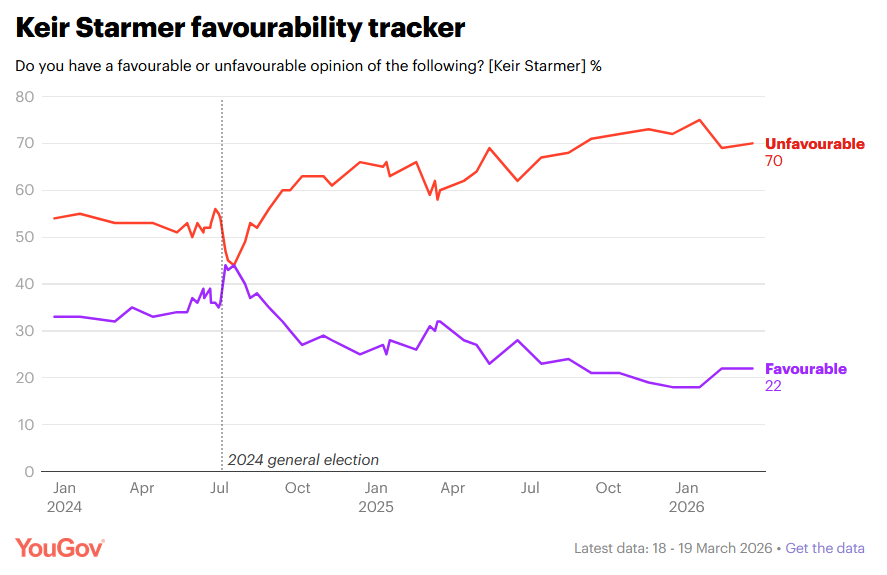
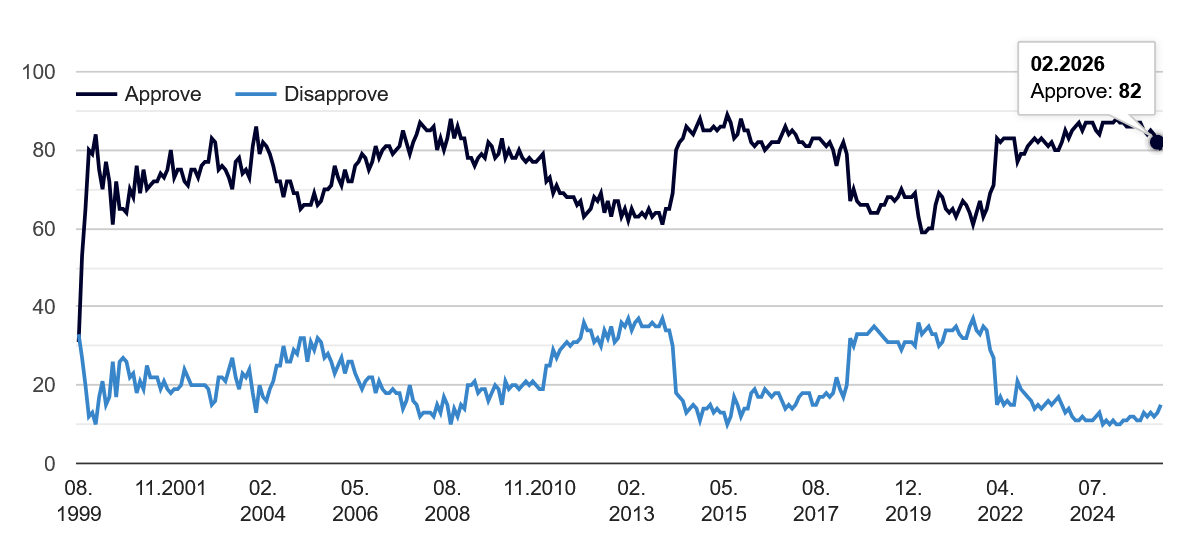
Two interesting opinion polls, in the genre of value-laden evidence. Wearing your evaluative thinking spectacles, what do you make of them?

What normative values informed your judgements? For example, you probably wouldn’t want to be just comparing the metrics!

What should the ratings be?

Starmer

Starmer’s favourability tracker (YouGov)

Putin

Putin’s approval rating (Levada)

“Yes, it did”

As innumerable hacks read their tea leaves to forecast what happens next, and debate who is responsible for whose downfall, this shows what an effective Opposition moment looks like – and why the Opposition sometimes, very occasionally, strengthens democracy (House of Commons, Wednesday 4 February 2026):

Mrs Badenoch: On 10 September, when we knew this, I asked the Prime Minister about it at the Dispatch Box, and he gave Mandelson his full confidence—not once but twice. He only sacked him after pressure from us. I am asking the Prime Minister something very specific, not about the generalities of the full extent. Can the Prime Minister tell us: did the official security vetting that he received mention Mandelson’s ongoing relationship with the paedophile Jeffrey Epstein?

Prime Minister: Yes, it did. As a result, various questions were put to him. […]

Mrs Badenoch: What the Prime Minister has just said is shocking. How can he stand up there saying that he knew, but that he just asked Peter Mandelson if the security vetting was true or false? This was a man who had been sacked from Cabinet twice already for unethical behaviour. That is absolutely shocking.

How likely or unlikely do you think it is that Keir Starmer will still be prime minister at the end of 2026? (YouGov, 5 January 2026, 4,667 GB adults, verys and fairlys summed):

AllConLabLib DemReform
Likely2919453915
Unlikely5570394476
Likely – unlikely-26-516-5-61
Don’t know171015168

Trots

Though I’m no longer an academic, I occasionally dip into what’s going on in higher education. Things look particularly grim right now.

This blog post from Dec 2023 caught my eye, co-authored by John Kelly, who has written an fantastic critical analysis of Trotskyism. The post takes a look at the politics of UCU Left, and has re-appeared in the context of UCU elections.

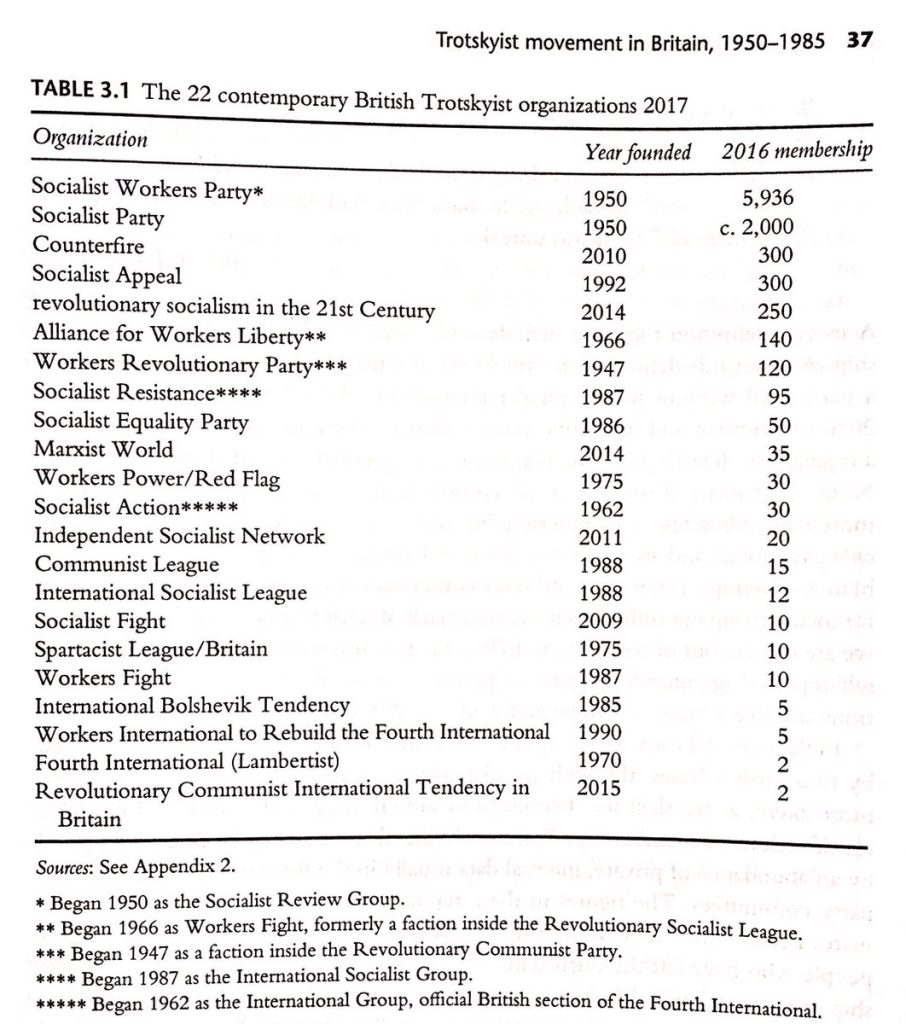
It reminded me of one of my all-time favourite tables: the number of members in British Trotskyist organisations (John Kelly, 2018).

Kelly, J. (2018). Contemporary Trotskyism: parties, sects and social movements in Britain. Routledge.

The problem with politics and evaluation

“The problem is that politics and evaluation are both intrinsically connected and intrinsically separated. We need independence if we’re to be competent, objective, and credible. However, independence can’t always be preserved without a fight; this doesn’t make us a lot of friends; and yet we need friends, partners, and teamwork to be effective in a political universe.”
—Eleanor Chelimsky (2008, p. 414). A Clash of Cultures: Improving the “Fit” Between Evaluative Independence and the Political Requirements of a Democratic Society. American Journal of Evaluation, 29(4), 400–415.

Russian state disinformation campaigns

Two interesting reports:

European Commission, Directorate-General for Communications Networks, Content and Technology (2023). Digital Services Act: Application of the risk management framework to Russian disinformation campaigns. Publications Office of the European Union.

“During the first year of Russia’s illegal war in Ukraine, social media companies enabled the Kremlin to run a large-scale disinformation campaign targeting the European Union and its allies, reaching an aggregate audience of at least 165 million and generating at least 16 billion views. Preliminary analysis suggests that the reach and influence of Kremlin-backed accounts has grown further in the first half of 2023, driven in particular by the dismantling of Twitter’s safety standards.”

Microsoft Threat Analysis Center (2023). Russia’s African coup strategy.

“Today we are sharing a report from the Microsoft Threat Analysis Center (MTAC) on Russian influence operations in Africa, principally focused on the Niger coup. We believe it is vital there is wider understanding of the ways in which the internet is being used to stoke political instability around the world.”