Is it a psychological treatment?

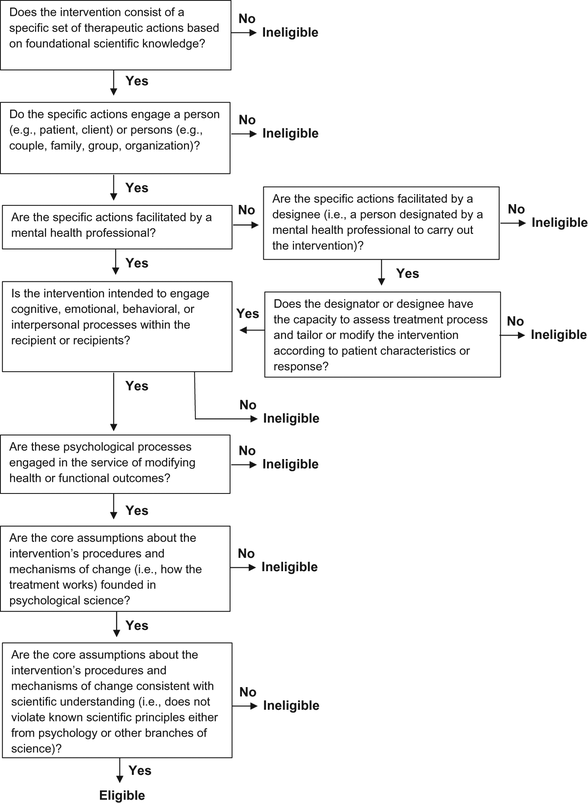
This by Tolin et al. (2025) looks interesting and controversial: Tolin, D. F., Grasso, D., Boness, C. L., Beck, J. G., Keane, T. M., Leichsenring, F., Olatunji, B. O., Otto, M. W., & Weinand, J. (2025). A proposed definition of psychological treatment and its relation to empirically supported treatments. Clinical Psychology: Science and Practice, 32(3), 213–225. https://doi.org/10.1037/cps0000220

Picture:

Is there any point in therapy if behaviour is “unavoidably determined”?

In an introduction to psychodynamic ideas, Jonathan Shedler (2022, p. 432) claims:

“If behavior were unavoidably determined, there would be no reason to practice psychoanalytic therapy or, for that matter, any form of therapy.”

Although I’m not sure about determinism, I think this assertion is false. I also believe it is important to understand why it is false for clients who do believe in determinism, such as the occasional philosopher.

Suppose behaviour were unavoidably determined. We still experience stuff, some of it fun, some of it not. Our accompanying conscientious sensations that go along for the ride doesn’t seem to care. Related to this, I think it’s interesting that we still go to the cinema and read books even though we know the ending has already been decided: we seem to derive great pleasure from finding out what happens next. “You should go on living, if only to satisfy your curiosity”, goes the Yiddish proverb.

Importantly for therapy, chatting with someone and feeling listened to partially determines what we do and how we feel. While it’s possible that therapy is merely another link in the massive causal network of the universe, it is hopefully more likely to improve someone’s life than other links, regardless of how predetermined going to see the therapist and its consequences might be. As Galen Strawson puts it (2010, p. 247, footnote 22):

“Naive fatalism holds that there is no point in doing anything because everything is predetermined […], hence nothing you can do can change how things will be. It is false, because one’s doings and deliberations can change things, being themselves real parts of the (possibly deterministic) causal process.”

References

Shedler, J. (2022). That Was Then, This Is Now: Psychoanalytic Psychotherapy For The Rest Of Us. Contemporary Psychoanalysis, 58, 405–437.

Strawson, G. (2010). Freedom and Belief, Revised Edition.

What helps/hinders school-based humanistic therapy?

Interesting thematic analysis (Cooper et al., 2015) of what helped and hindered in school-based humanistic therapy, as part of the large ETHOS RCT. The approach the researchers took started with open questions and coding inductively, then concluded with closed questions and deductive coding based on what the theory suggested might help or not. All the usual helpful things were there, like:

“[The therapist] wasn’t, like, doing something else. She was sat there all the time just like listening to me.”

“They just talked to me like I was a human being not like, ‘Oh, you know, what teenagers are like…'”

“It was like they were taking in what I was actually saying and then the questions afterwards were based upon that.”

I was struck by the number of young people who mentioned the therapist providing advice, given that the humanistic approach is supposed to be non-directive (there is some discussion of this). Sometimes this advice was welcome and young people who didn’t receive any advice indicated that they didn’t see the point of therapy without it.

“I used to have an argument with this girl…and the therapist said to just leave it because she’s just going to– she wants attention and she wants a reaction out of me. She [the therapist] was just like, “Leave it. She can say whatever she wants and then she’ll stop it herself,” and now that girl doesn’t even say anything to me because I don’t even say anything to her.”

Advice/guidance wasn’t always experienced as helpful; the examples given seem to be all “technique”:

“[The therapist] would do breathing exercises and imagine things, and I didn’t like that. I said, “I didn’t like that,” and [the therapist] was like, “Well, let’s just try.” “I don’t want to do it.” “Well, let’s just try.” [The therapist] was kind of persistent on something that I didn’t want to do.”

There’s also a collection of things some therapists did which were seen as particularly unhelpful, e.g.,

“She didn’t have a lot to say. She would just sit there and stare at me for sometimes three minutes at a time. Literally it was three minutes. She’d just sit there, and I’d be looking around the room, and every time I looked back at her, she’s just looking at me. She wouldn’t say anything.”

(Reminds me of Levitt’s 2001 thematic analysis of the twenty or so different kinds of silence!)

Wonder if anyone has tried to crowdsource these helpful/hindering ideas at scale.

References

Cooper, M., Smith, S., Sumner, A. L., Eilenberg, J., Childs-Fegredo, J., Kelly, S., Subramanian, P., Holmes, J., Barkham, M., Bower, P., Cromarty, K., Duncan, C., Hughes, S., Pearce, P., Rameswari, T., Ryan, G., Saxon, D., & Stafford, M. R. (2025). Humanistic Therapy for Young People: Client-Perceived Helpful Aspects, Hindering Aspects, and Processes of Change. Journal of Child and Family Studies.

Levitt, H. M. (2001). Sounds of Silence in Psychotherapy: The Categorization of Clients’ Pauses. Psychotherapy Research, 11(3), 295–309.

Exploring the validity of sentiment analysis in psychotherapy

What happens if you apply the Multilingual Language Model Toolkit for Sentiment Analysis (XLM-T), “a transformer-based NLP model derived from the Cross-lingual Language Model based on RoBERTa”, to psychotherapy transcripts? Eberhardt et al. (2024) investigate. Here’s a slightly simplified Table 1, showing correlations between positive and negative sentiment and a patient-reported emotions scale. Green gives between-patient correlations and pink within-patient across sessions. Note the wide confidence intervals.

Eberhardt, S. T., Schaffrath, J., Moggia, D., Schwartz, B., Jaehde, M., Rubel, J. A., Baur, T., André, E., & Lutz, W. (2024). Decoding emotions: Exploring the validity of sentiment analysis in psychotherapy. Psychotherapy Research.

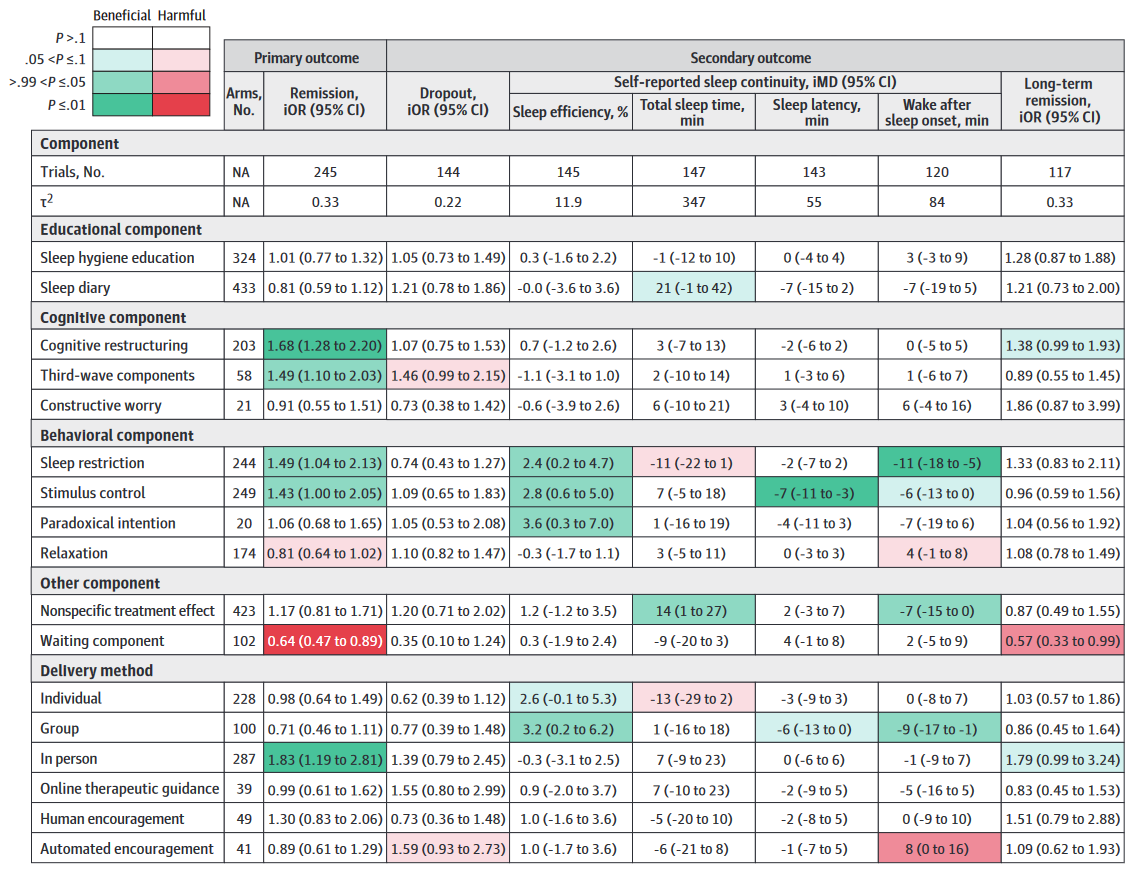
Components and delivery formats of therapy for chronic insomnia

Interesting meta-analysis by Furukawa et al. (in press) of 241 trials, aiming to work out what components of therapy lead to better outcomes for people with chronic insomnia.

References

Furukawa Y., Sakata M., Yamamoto R., et al. Components and Delivery Formats of Cognitive Behavioral Therapy for Chronic Insomnia in Adults: A Systematic Review and Component Network Meta-Analysis. JAMA Psychiatry. Published online January 17, 2024.

Intent-to-fail treatments

Westen et al. (2004, p. 651) on “intent-fo-fail” conditions in randomised controlled trials comparing two interventions with each other:

‘Researchers should also exercise caution in labeling control treatments not constructed to maximize their efficacy ([…] what might be called intent-to-fail conditions) with brand names that are readily confused with genuine treatments and create sleeper effects in the literature. For example […] to test the efficacy of CBT for bulimia, Garner et al. (1993) developed a treatment they called supportive– expressive therapy, an abbreviated treatment described as nondirective and psychodynamically inspired, in which clinicians were forbidden to discuss the target symptoms with the patient and were instead instructed to reflect them back to the patient. Such a practice is not in fact characteristic of psychodynamic therapies for eating disorders (e.g., Bruch, 1973) and is analogous to a researcher creating a cognitive therapy comparison condition in which the therapist is instructed to say, “That’s irrational,” every time a patient tries to discuss the symptom.’

References

Westen, D., Novotny, C. M., & Thompson-Brenner, H. (2004). The Empirical Status of Empirically Supported Psychotherapies: Assumptions, Findings, and Reporting in Controlled Clinical Trials. Psychological Bulletin, 130(4), 631–663.

Comment on Peter Kinderman’s blog post

(Peter’s blog post.)

Peter Kinderman seems to be arguing that it doesn’t matter if an experience is classified as resulting from disease, illness, disorder, or a response to circumstance (genetically mediated or otherwise). People who have “obvious and quantifiable needs” should get the help they need with social challenges which may have led to the difficulties in the first place. They should have someone to talk to so they can make sense of what has happened. Removing the category of illness doesn’t remove distress, doesn’t mean people shouldn’t be helped. This makes a lot of sense.

Much has been said about the problems with diagnostic categories and with naïve reification to biological entities. You have disease D if and only if you have symptoms S1, S2, … Sn. Why do you have those symptoms? Why of course it’s because you have disease D. I think we can safely conclude, along with many others, that this is circular. An argument that we “need” diagnoses to care for people is unconvincing.

Should we completely throw away what has been collected in diagnostic tomes? I don’t think we should.

One complaint about DSM and ICD is that they cover all aspects of human experience. Most of us can find a diagnosis in there, especially if interpreting the descriptions broadly. But in many ways this is a strength — when naïve reification is eliminated. Denny Borsboom, Angelique Cramer and others have done important work extracting the individual complaints (e.g., loss of interest, thinking about suicide, fatigue, muscle tension) which make up diagnoses and modelling how they relate to each other (Borsboom, Cramer, Schmittmann, Epskamp, & Waldorp, 2011; Borsboom & Cramer, 2013). The individual descriptions and their interrelationships might gain in meaning when stripped of their diagnostic group.

Describing the sorts of situations people find themselves in and how they feel is crucial for conducting research and helping build up evidence for what works. When is talking therapy helpful? When might it make more sense for people to work four days a week rather than five? When should a focus be on interpersonal problems and who should be involved in sessions?

DSM-5 includes a chapter on “Other conditions that may be a focus of clinical attention” (American Psychiatric Association, 2013, pp. 715–727). It’s brief, making up only about 2% of the book, and should be expanded, however, it seems relevant to a psychosocial approach and could perhaps be combined with other descriptions of predicaments and problems. Example problems include:

  • High expressed emotion level within family
  • Spouse or partner violence
  • Inadequate housing
  • Discord with neighbour, lodger, or landlord
  • Problem related to current military deployment status
  • Academic or education problem
  • Social exclusion or rejection
  • Insufficient social insurance or welfare support

So, “DSM” is not synonymous with “biological”. There is again plenty to be built upon, despite its problems.

Kinderman argues that practitioners “can offer practical help, negotiate social benefits (which could be financial support, negotiated time off work, or deferred studies, for example), or offer psychological or emotional support.” It was great to see specific examples. Medication also likely has a place, especially when the mechanisms of action are conceptualised in a drug-centred way rather than keeping up the pretence that they cure a disease (Moncrieff & Cohen, 2005). I think we all should be doing more to elaborate how a meaningful psychosocial approach can work in practice.

References

American Psychiatric Association. (2013). Diagnostic and statistical manual of mental disorders (5th ed.). Washington, DC.

Borsboom, D., & Cramer, A. O. J. (2013). Network analysis: an integrative approach to the structure of psychopathology. Annual Review of Clinical Psychology, 9, 91–121. doi:10.1146/annurev-clinpsy-050212-185608

Borsboom, D., Cramer, A. O. J., Schmittmann, V. D., Epskamp, S., & Waldorp, L. J. (2011). The small world of psychopathology. PloS ONE, 6(11), e27407. doi:10.1371/journal.pone.0027407

Moncrieff, J., & Cohen, D. (2005). Rethinking models of psychotropic drug action. Psychotherapy and Psychosomatics, 74, 145–153. doi:10.1159/000083999

Worrying developments in NHS England mental health outcomes monitoring

Mental health service users hope that the therapeutic interventions they receive will help them feel better. Randomised controlled trials are one important way to test whether a therapy “works”; however, they don’t reveal how interventions are experienced in routine care. This has led to routine outcomes monitoring which uses questionnaires to ask service users and clinicians to rate symptoms and other relevant information before, during, and after treatment. Outcomes monitoring has been used by NHS services for some years, for example through the Child Outcomes Research Consortium and Improving Access to Psychological Therapies (IAPT). It is, however, controversial. Ros Mayo (2010, p. 63) for example argues that:

“The application of oversimplified questions requiring tick-box answers … are driven by short-term and superficial policies and management techniques, largely incorporated from industry and the financial sector and primarily concerned with speed, change, results, cost effectiveness – turnover and minimising human contact and time involvement… They have nothing to do with human engagement…”

And yet, outcomes monitoring could be better than bureaucracy. There is emerging evidence that providing regular progress feedback to clinicians improves outcomes, especially when questionnaires are completed by service users. Intuitively this seems to make sense: people could sometimes reveal more about how they feel on paper than they can orally face-to-face. Items used in IAPT include:

  • “How often have you been bothered by… not being able to stop or control worrying?”
  • “Heart palpitations bother me when I am around people”

They also ask directly about the care received, for example:

  • “Did staff listen to you and treat your concerns seriously?”
  • “Did you feel involved in making choices about you treatment and care?”

Responses to these items could help clinicians understand to what extent services are helping service users. Also using standardised questionnaires means that expected progress curves can be developed (for example see work by Lambert and colleagues), so clinicians can see, for example, if progress is slower than would be expected given initial assessment and, if warranted, try a different approach.

It’s early days for outcomes monitoring but the above examples suggest that it could be a promising approach. However, closer examination shows that there are clear problems with how questionnaires are being used in practice, and I think NHS services in England are being asked to implement actively damaging approaches to outcomes monitoring.

Problem 1. Use of an unreliable measure

Suppose you wish to develop a rating scale for quality of life or how distressed you are so that you can monitor progress over time with a summary “score”. As a bare minimum requirement, all of the questions for one topic should be related to each other: the items should be “internally consistent”. This questionnaire probably wouldn’t do very well:

THE GENERAL STUFF QUESTIONNAIRE

  1. How often do you sing in the shower?
  2. What height are you?
  3. How far do you live from the nearest park?
  4. What’s your favourite number?
  5. How often do you go dancing?

You might learn interesting things from some of the individual answers, but summing all the answers together is unlikely to be revealing. This questionnaire would fare better:

THE RELIABLE FEELINGS QUESTIONNAIRE

  1. How do you feel? (0 is terrible, 10 fantastic)
  2. How do you feel? (0 is terrible, 10 fantastic)
  3. How do you feel? (0 is terrible, 10 fantastic)
  4. How do you feel? (0 is terrible, 10 fantastic)
  5. And finally… how do you feel? (0 is terrible, 10 fantastic)

However, you might wonder if questions 2 to 5 add anything. There are many ways to test the internal consistency of questionnaires, using the answers that people give. One is to use a formula called Cronbach’s alpha which gives answers from 0 to 1. Higher, say around 0.8, is better. Too close to 1 suggests redundancy in questions, as would be likely for the Reliable Feelings Questionnaire above.

In England, it is now recommended to use a “Mental Health Clustering Tool” to evaluate outcomes (see section 7.1 of recent guidelines). This is a questionnaire completed by clinicians covering areas such as hallucinations, delusions, depression, and relationship difficulties. The questionnaire suffers from a very basic problem: it’s not internally consistent. This has been discovered by the very people who proposed the approach (see p.30 of their report): “As a general guideline, alpha values of 0.70 or above are indicative of a reasonable level of consistency”. Their results are: 0.44, 0.58, 0.63, 0.57 – conspicuously smaller than 0.70. The authors also refer to previous studies explaining that this would always be the case, due to “its original intended purpose of being a scale with independent items” (p. 30). So, by design, it’s closer to the General Stuff Questionnaire above: a mixed bag of independent questions with low reliability.

Problem 2. Proposals to link outcomes to payment

Given evidence that collecting regular feedback might improve the quality of care people receive, it may be a good idea that the IAPT programme includes regular progress monitoring. IAPT uses service user completed questionnaires, which could in principle provide information clinicians might not otherwise have learned. There is, however, another potential difficulty over and above that of the quality of questionnaires used, and that is how external influences such as “Payment by Results” (PbR) initiatives can change for the worse how data is gathered and used. And PbR initiatives are beginning to be used in practice. The IAPT webpage notes, “An outcome based payment and pricing system is being developed for IAPT services. This is unique as other systems of PbR are activity or needs based.” Initial pilot results were “encouraging,” says the web page, and another pilot is currently running.

The idea with this proposal is that the more improvement shown by service users, as partly determined by outcomes scores, the more money service providers would receive. This is a worry as linking measures to targets has a tendency to cause the measures to stop measuring what it is hoped that they measure. For instance targets on ambulance response times have led to statistically unlikely peaks at exactly the target, suggesting that times have been changed. A national phonics screen has a statistically unlikely peak just at the cutoff score, suggesting that teachers have rounded marks up where they fell just below the cutoff. The effect has been around for such a long time that it has a name, Goodhart’s law:

“Any observed statistical regularity will tend to collapse once pressure is placed upon it for control purposes.”

Faced with funding cuts, how many NHS managers in overstretched services will be forced to “game” performance-based payment systems to ensure their service survives? It’s not hard to do so, for example people who drop out of therapy tend to do so because they didn’t think it was helping. It can be easy to justify not asking people who leave therapy to complete questionnaires. Those who stay in therapy may be the ones with higher scores (see Clark, 2011, p. 321). Therefore, the missing data from those whom therapy was not helping could lead to a false picture of how well a service is working for service users. It is difficult to see how any data gathered that has been subject to these difficulties could tell clinicians or service providers anything helpful about their services or the wellbeing of those who use them.

Concluding thoughts

I think it is possible that statistically reliable, high quality questionnaires could be helpful in clinical practice, if thoughtfully used and explained to service users. Perhaps such questionnaires could be thought of as a bit like blood pressure readings; few patients feel reduced to numbers when told their results, and it’s obvious that more information is required to formulate a treatment if something is awry. However, using unreliable measures – especially when the developers know they are unreliable – is unacceptable for a national mental health programme. Moreover, linking questionnaire scores to payment raises even more complex ethical issues: there is a risk that the bureaucratic burden of questionnaires for service users would increase; also poorer treatment and financial decisions could result because those decisions would be made on the basis of low quality, unreliable data. Mental health services need to do much better than that, for the sake of everyone’s wellbeing.

Thanks very much to Martha Pollard and Justine McMahon for helpful comments.

Andy Fugard is a Lecturer in Research Methods and Statistics at the Department of Clinical, Educational and Health Psychology, University College London. His research investigates psychological therapies for children and young people: are they effective in routine practice and what moderates effectiveness. He is also interested in policy around practice-based evidence and recently became a member of the NHS England/Monitor Quality and Cost Benchmarking Advisory Group.
Why can psychological therapy be helpful?

Research explaining how therapy might help is saturated with pretentious jargon, e.g., invoking “transference”, “extinction”, heightening access to “cognitive–emotional structures and processes”, “reconfiguring intersubjective relationship networks” (see over here for more).

Could simpler explanations be provided? Here are some quick thoughts, inspired by literature, discussing with people, and engaging myself as a client in therapy:

  • You know the therapist is there to listen to you – they’re paid to do so – so there’s less need to worry about their thoughts and feelings. One can and is encouraged to talk at length about oneself. This can feel liberating whereas in other settings it might feel selfish or self-indulgent.
  • The therapist keeps track of topics within and across sessions. This can be important for recognising patterns and maintaining focus, whilst allowing time to tell stories, meandering around past experiences, to see where they lead.
  • The therapist has knowledge (e.g., through literature, supervisory meetings, and conversations with other clients) of a range of people who may have had similar feelings and experiences. So although we’re all unique, it can also be helpful to know that others have faced and survived similar struggles – especially if we learn what they tried and what helped.
  • Drawing on this knowledge, the therapist can conjecture what might be going on. This, perhaps, works best if the conjectures are courageous (so a step or two away from what the clients says) – and tentative, so it’s possible to disagree.
  • There can be an opportunity for practice, for instance of activities or conversations which are distressing. Practicing is a good way to learn.
  • Related, there’s a regular structure and progress monitoring (verbally, with a diary, or using questionnaires). Self-reflection becomes routine and constrained in time, like (this might be a bit crude but bear with me) a psychological analogue of flossing one’s teeth.
  • (Idea from Clare) “… daring to talk about things never spoken of before with someone who demonstrates compassion and acceptance; helpful because allows us to face things in ourselves that scare us and develop less harsh ways of responding to ourselves”
  • The therapist has more distance from situations having an impact on someone than friends might have so, e.g., alternative explanations for interpersonal disputes can more easily be provided.
  • It’s easier for a therapist to be courageous in interactions and suggestions than for a friend as – if all goes wrong – it’s easier for the client to drop out of the therapeutic relationship without long-term consequences (e.g., there’s no loss of friendship).
  • Telling your story to a therapist gives you an audience who is missing all of the context of your life. Most of the context can feel obvious, until you start to tell your story. Storytelling requires explaining the context, making it explicit. For instance who are the people in your life? Why did you and others say and do the things they did? Perhaps this act of storytelling and making the context explicit also makes it easier to become aware of and find solutions.