PM vs. Reform leader (3 June 2026)

PM: “The grieving family have asked us not to respond in the way that the leader of Reform has responded. They have lost their son in the most appalling circumstances, and they make a simple plea of us as human beings to please not exploit that. We all need to reflect on the words of Henry’s father.

“My response—and the response of others, to be fair—has been focused on the lessons to be learned so that we can deliver justice. The hon. Gentleman’s response has been to appeal for rage. That is his response to a father who has lost his son and asked for that not to happen. Exploiting this tragedy to create grievance and division would be wrong in any circumstances, but to do it when the family are expressly saying, “Please don’t,” is unforgivable. It shows exactly who he is.”

(PMQs, Wednesday 3 June 2026)

Resignations

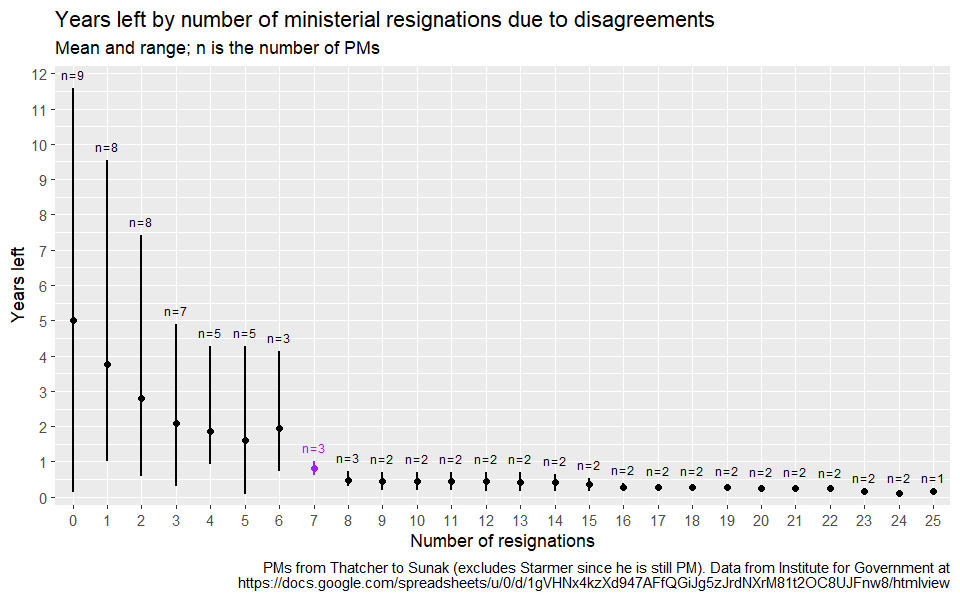
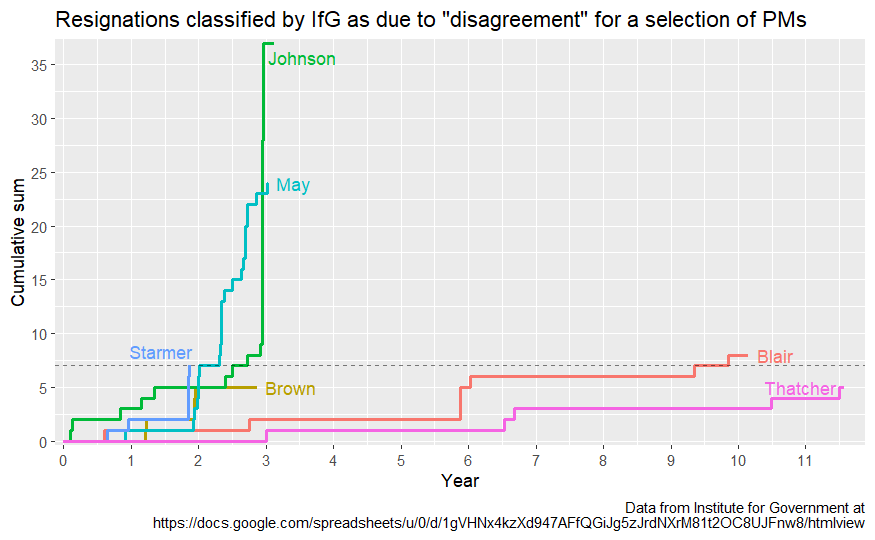
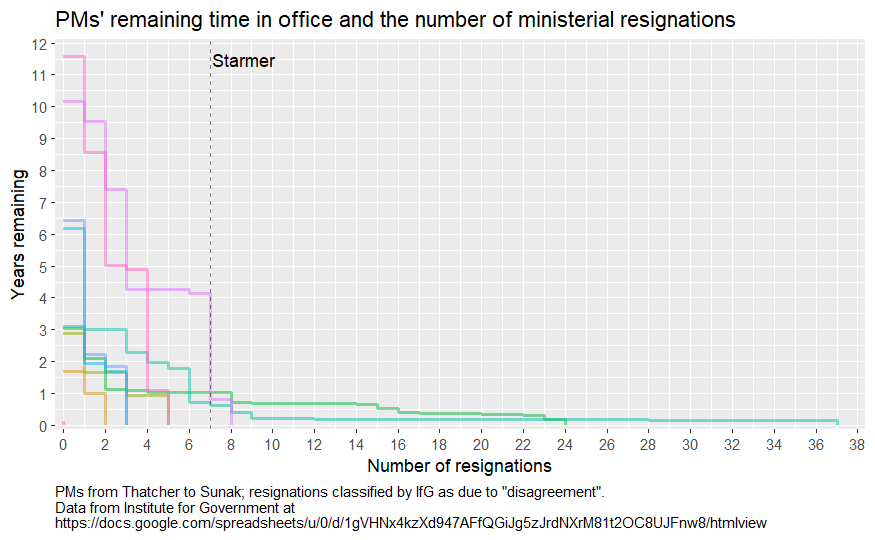
Interesting dataset from the Institute for Government. (I last updated this after Streeting resigned.)

Here’s a cumulative count of resignations that were coded by IfG as being due to “disagreement”, for a selection of PMs. The dashed horizontal line shows Starmer’s count:

Expanding out to all PMs in the data (from Thatcher to Sunak), how long did they have left as the number of resignations grew? (Note: different colours – also remember the small number of PMs!)

Another attempt to visualise (again, remember small n – the lines give a range not uncertainty!). Purple marks where Starmer is currently at, though the data excludes him since he’s still PM.

“It is not unheard of for permanent secretaries, in a sense, to try and work in a way which allows there to be a decision”

Edward Morello: Well, we should put on record that you have served under four different Prime Ministers. At any point during your tenure as perm sec, were you asked by a No. 10 organisation to withhold information from the Foreign Secretary? How usual is that request?

Sir Philip Barton: I am worried that everyone is going to think that the centre of Government spends its whole time sort of conniving behind the backs of everyone else in Government. That is not the reality. The reality is people trying to get on with delivering the business of the Government the vast majority of the time. My best answer to that question is that it is unusual. However, in the end, it is particularly around things where you might have a policy disagreement or difference of view between the Prime Minister and the Secretary of State.

It is not unheard of for permanent secretaries, in a sense, to try and work in a way which allows there to be a decision, and a consensus view in the Government to then move ahead and take it forward. In that sort of situation, it is not unheard of for a permanent secretary to be privy to something that they are asked not to pass on to their Secretary of State. I would describe it as not unheard of, but I do not want to give the impression that this is standard operating procedure.

Q344 Chair (Emily Thornberry): But this is absolutely extraordinary. The permanent secretary at the Foreign Office can be told, “Don’t tell your boss about this” when they are the Foreign Secretary? Has that ever happened to you before this?

Sir Philip Barton: Yes, it has.

Q345 Chair: Really?

Sir Philip Barton: Yes.

Chair: Well, you learn something new every day.

(Oral evidence: Work of the Foreign, Commonwealth and Development Office, HC 385, Tuesday 28 April 2026)
Trots

Though I’m no longer an academic, I occasionally dip into what’s going on in higher education. Things look particularly grim right now.

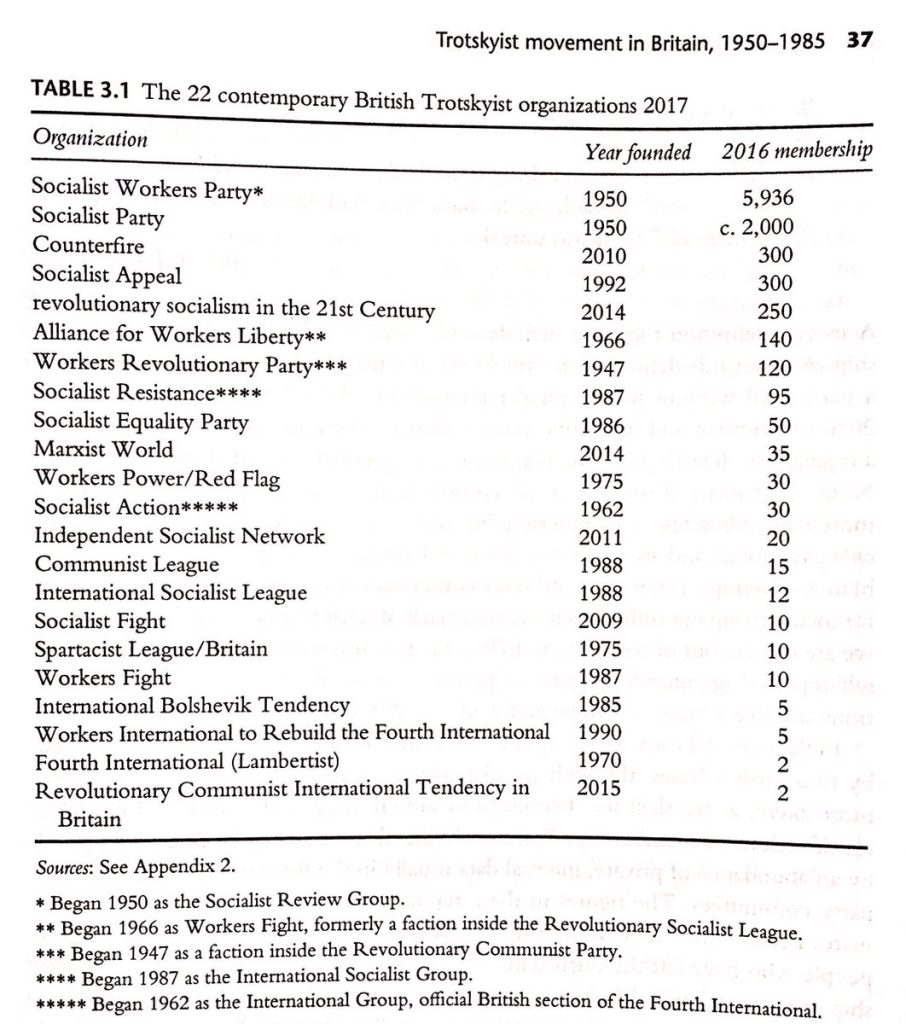
This blog post from Dec 2023 caught my eye, co-authored by John Kelly, who has written an fantastic critical analysis of Trotskyism. The post takes a look at the politics of UCU Left, and has re-appeared in the context of UCU elections.

It reminded me of one of my all-time favourite tables: the number of members in British Trotskyist organisations (John Kelly, 2018).

Kelly, J. (2018). Contemporary Trotskyism: parties, sects and social movements in Britain. Routledge.

NAO (2024), A planning and spending framework that enables long-term value for money

New National Audit Office (NAO) report with interesting analysis, examples of positive change such as the creation of the Evaluation Registry, and further recommendations regarding the role of evaluation in UK government planning and spending. For example:

“Data quality is a problem in government which makes monitoring both costs and value harder. […] Even where data are available, we see examples of a ‘good news culture’ in some major programmes and government bodies, that disincentivises transparent reporting of performance.” [2.27]

“Evaluation is sometimes perceived as apportioning blame, instead of as a neutral learning mechanism. If an evaluation shows a lack of progress, it might lead to a programme losing funding or being cancelled. This acts as a disincentive to evaluate.” [2.28]

“The previous government also committed to making the evaluation registry open to the public, although that has not yet occurred.” [2.66]