Research involves immersing yourself in the literature; engaging in a struggle to try to keep up with key findings in your field; critically engaging with studies, learning from their strengths and unintentional errors and mishaps to improve your work; attending conferences and debating in and between sessions to reach an informed view on what’s going on; maintaining collections of papers that may be relevant in future, e.g., using reference managers like Zotero to keep track and aid searching, annotation, and citation.
LLMs can’t engage and think for you, can’t magically place the ideas in your brain, fails to find papers that a simple literature search uncovers. But the literature is being flooded by complete nonsense, driven by some researchers’ credulous reliance on what LLMs produce. Bixonimania is a great illustration of what can go wrong, but the prevalent examples are more subtle – worth a read of the Nature writeup: Scientists invented a fake disease. AI told people it was real.
Tag: bullshit
AI provenance problem
Earp et al. (2025) in a picture. You write some rough notes, magic it into a fully-formed idea using an LLM, but end up plagiarising a decades-old paper that was buried in the training set. Add that to the growing stack of concerns: AI slop, “hallucinations” (also known as falsehoods, misinformation, or BS), and looming climate catastrophe accelerated by the data and compute centres powering AI.
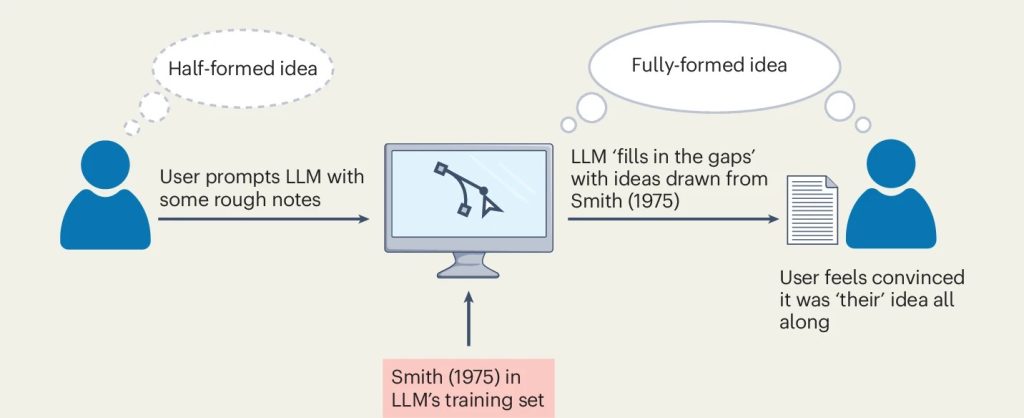
Earp, B. D., Yuan, H., Koplin, J., & Porsdam Mann, S. (2025). LLM use in scholarly writing poses a provenance problem. Nature Machine Intelligence.
ChatGPT has indifference towards the truth of outputs
An interesting analysis of the output of LLMs (Hicks et al., 2024), according to a typology developed by Harry Frankfurt. That ChatGPT and co aren’t people with agency constrains the genre that can apply, similarly to analyses of trust (see, e.g., Castelfranchi and Falcone on whether a computer can trust).
References
Hicks, M. T., Humphries, J., & Slater, J. (2024). ChatGPT is bullshit. Ethics and Information Technology, 26(2), 38.
“Oops! We Automated Bullshit.”
“AI systems like ChatGPT are trained with text from Twitter, Facebook, Reddit, and other huge archives of bullshit, alongside plenty of actual facts (including Wikipedia and text ripped off from professional writers). But there is no algorithm in ChatGPT to check which parts are true. The output is literally bullshit, exactly as defined by philosopher Harry Frankfurt…”
– Alan Blackwell (2023, Nov 9), Oops! We Automated Bullshit.
Communication is probably more than 7% verbal

“Have you ever heard the adage that communication is only 7 percent verbal and 93 percent non-verbal, i.e. body language and vocal variety? You probably have, and if you have any sense at all, you have ignored it.” I have, in a presentations skills training course.
Philip Yaffe wades into the 1967 studies that produced this oft-cited 7% figure:
Subjects were asked to listen to a recording of a woman’s voice saying the word “maybe” three different ways to convey liking, neutrality, and disliking. They were also shown photos of the woman’s face conveying the same three emotions. They were then asked to guess the emotions heard in the recorded voice, seen in the photos, and both together. The result? The subjects correctly identified the emotions 50 percent more often from the photos than from the voice.
In the second study, subjects were asked to listen to nine recorded words, three meant to convey liking (honey, dear, thanks), three to convey neutrality (maybe, really, oh), and three to convey disliking (don’t, brute, terrible). Each word was pronounced three different ways. When asked to guess the emotions being conveyed, it turned out that the subjects were more influenced by the tone of voice than by the words themselves.
The conclusion:
The fact is Professor Mehrabian’s research had nothing to do with giving speeches, because it was based on the information that could be conveyed in a single word.
The original studies behind the figure look interesting for what they actually tried to do rather than the bullshit claims that are still being repeated in corporate training.
Originals
Mehrabian, A., & Wiener, M. (1967). Decoding of inconsistent communications. Journal of Personality and Social Psychology, 6(1), 109–114.
Mehrabian, A., & Ferris, S. R. (1967). Inference of attitudes from nonverbal communication in two channels. Journal of Consulting Psychology, 31(3), 248–252.
Can you bullshit a bullshitter?
You can bullshit a bullshitter, except if they also have high cognitive ability, according to Littrell et al. (2021).

Littrell, S., Risko, E. F., & Fugelsang, J. A. (2021). ‘You can’t bullshit a bullshitter’ (or can you?): Bullshitting frequency predicts receptivity to various types of misleading information. British Journal of Social Psychology, 60(4), 1484–1505.