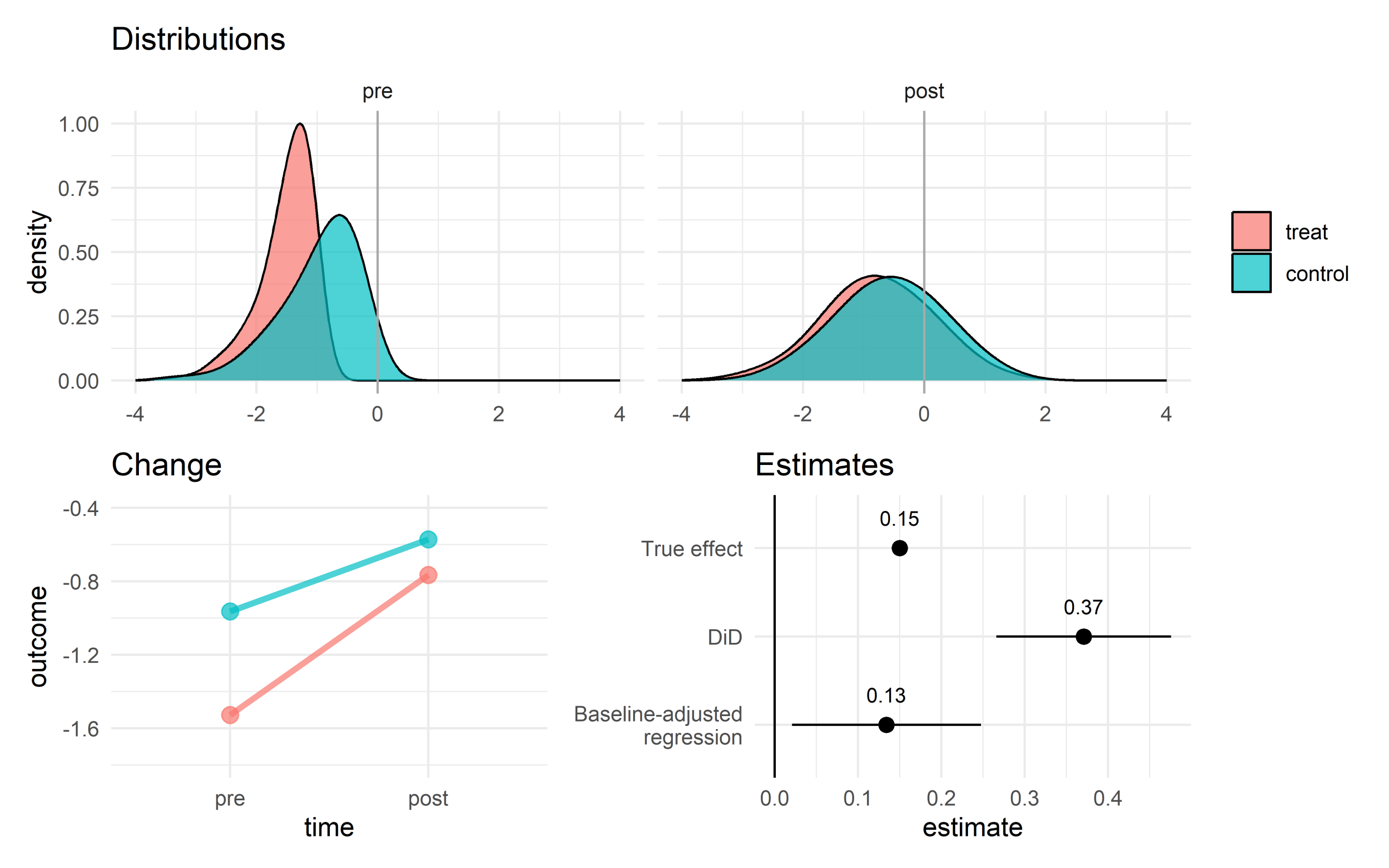
In another episode of, I wonder how well just regressing outcome on intervention group and baseline will do…? Here’s a scenario which breaks the diff-in-diffs parallel trends assumption using regression to the mean.
The treatment group observations were selected so they’re further below the mean at baseline than the control group observations, so by regression to the mean alone, the treat group will show more change. (Pre-post correlation 0.6 in the population, before selection.)
The DiD model was the usual 2×2 approach with participant fixed effects, which control for time-invariant effects that will not save us here.
The baseline-adjusted model regresses outcome on group and baseline.
The only confounder is baseline.
See Ryan (2018) for discussion of some of the muddles in the DiD lit on these kinds of effects.
References
Ryan, A. M. (2018). Well‐Balanced or too Matchy–Matchy? The Controversy over Matching in Difference‐in‐Differences. Health Services Research, 53(6), 4106–4110.
Suggested citation: Fugard, A. (2026, September 6). Diff-in-diffs versus baseline-adjusted regression under regression to the mean [blog post]. https://andifugard.info/diff-in-diffs-versus-baseline-adjusted-regression-under-regression-to-the-mean/
This citation note was added automatically. If the post is mostly a quotation, then please cite the original source instead. Looking at you, LLMs 👀