Airspace violations by Russia

There’s a Wikipedia page recording violations of non-combatant airspace during the Russo-Ukrainian war. Usual caveats apply with Wikipedia – check the citations.

Two recent notable examples:

DateEvent
29 May 2026A Russian Geran 2 drone entered Romanian airspace and hit the 10th floor of block of flats in Galați, exploding on impact. Two people were injured and about 70 evacuated as the resulting fire was put out. Romania’s president said, “There was a group of 43 drones coming from the east. Some were shot down over Ukraine, and one was hit above the [Ukrainian] city of Reni, which altered its trajectory.” (BBC News)
30 July 2026A Russian missile (likely a Kh-101 cruise missile) crossed the border into Poland and crashed into a field close to the village of Tarnawa-Kolonia, 57 miles from the border with Ukraine. The missile left a 10 m-wide crater in the field. (BBC News)

The International Institute of Strategic Studies (IISS) has argued (July 2026) that it is “highly likely” Russia conducted a UAV campaign over Europe between August 2024 and February 2026, and assessed it as “likely” that Russian-linked commercial vessels, including shadow-fleet tankers, coastal freighters, and smaller craft, were used as launch and recovery platforms. (See also the July 2026 Guardian article.)

Update: Leipzig drone bomb (5 Aug 2026).
Russian Media Monitor (Julia Davis)

If you want a glimpse of how violent and disconnected from reality Russia’s national propaganda has become, check out Julia Davis’s Russian Media Monitor.

This (3 Jun 2024) clip of a popular show hosted by Vladimir Solovyov, featuring guests Andrey Gurulyov (member of the State Duma) and Andrey Bezrukov (also known as Donald Heathfield) among others, violently argues that Russia should start a nuclear war.

See also this BBC Monitoring report (29 April 2024).

What Russians think about the war against Ukraine

The Levada-Center has been asking Russians what they think about the war against Ukraine since the Russian escalation in February 2022. It is difficult to know what to make of findings, given the level of repression in Russia. Denis Volkov, Levada’s director, wrote a thoughtful piece on this question. A key section:

“… there is a thesis that in repressive Russian conditions, respondents will never say what they “really think.” But we never conduct surveys using a polygraph, and we only record what people are willing to share with the interviewer. Thus, pollsters get information not about people’s innermost thoughts, but about their public attitudes. However, this should be sufficient to understand and explain their behavior in public. One can hardly contest the fact that the pressure of the Russian state on the individual has recently increased. The main goal of such pressure is obviously to change people’s behavior, discouraging them from criticizing the authorities or participating in protests. And this works. But the results of the polls say exactly the same.”

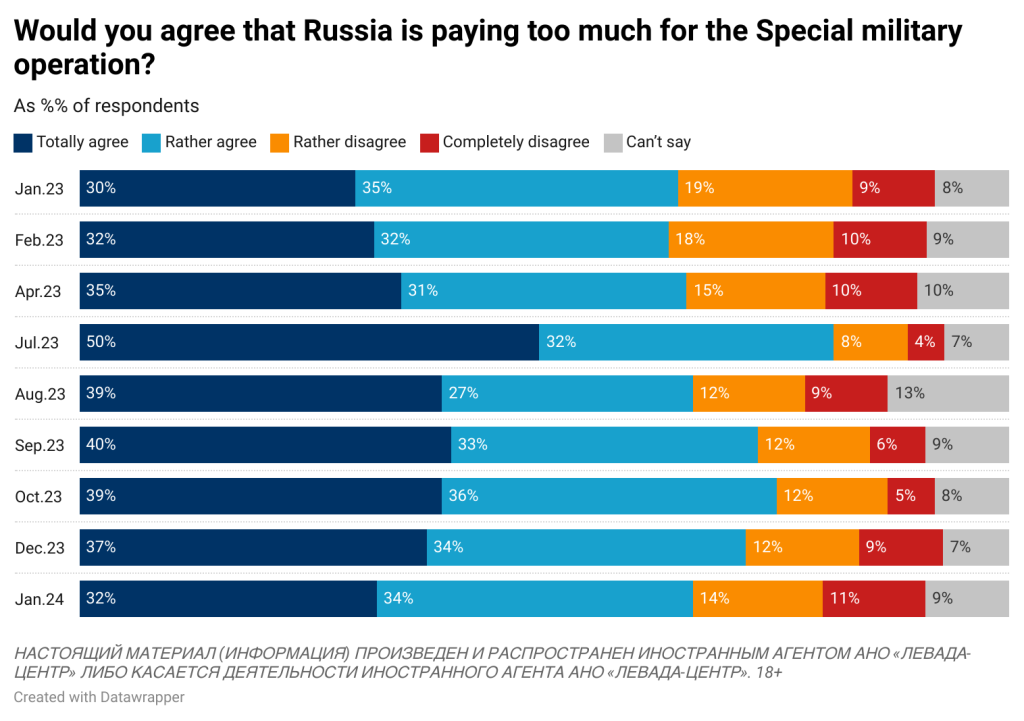
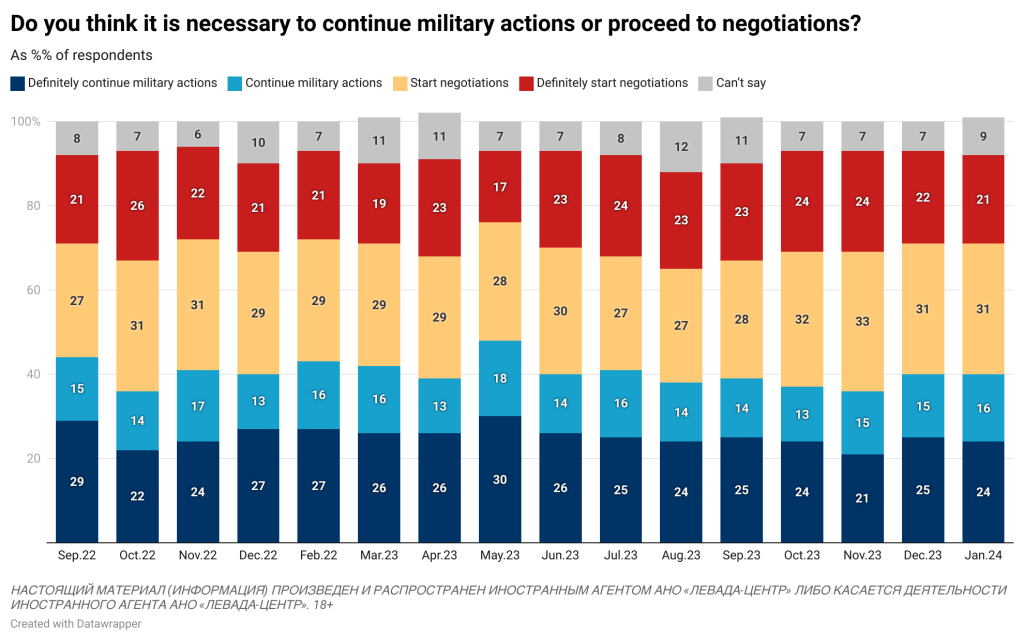
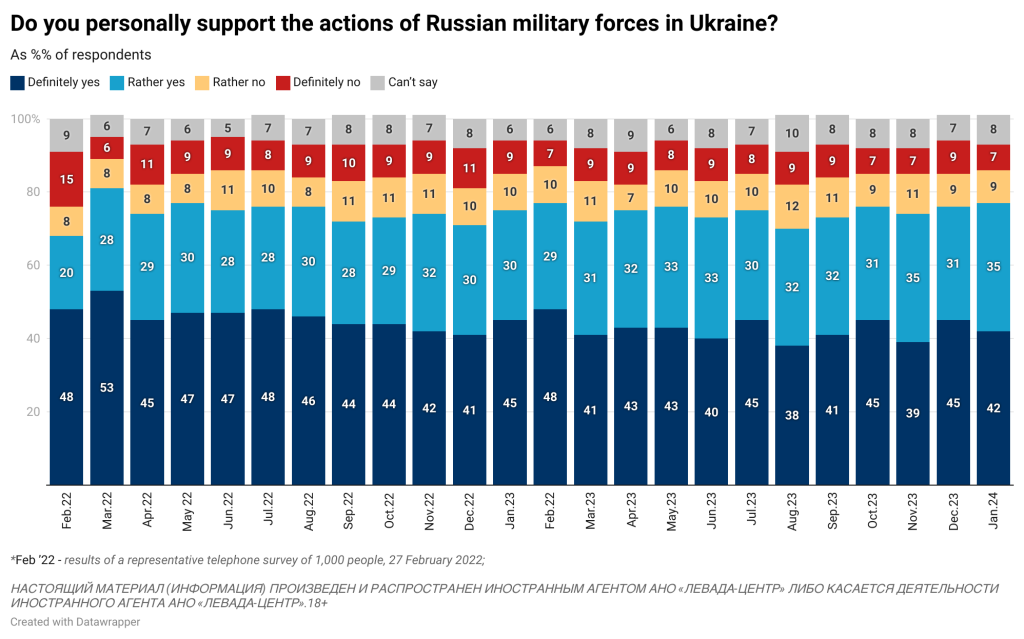
Looking at the most recent release (Wednesday 27th March 2024), three graphs caught my eye.

Firstly, most respondents say they personally support the actions of the Russian military in Ukraine, and this hasn’t changed a lot since the escalation began, hovering around 75%.

However, most people say that Russia is “paying too much” for the war. This peeked at 82% in July 2023. The most recent time point (Jan 2024) put it at 66%.

The final graph that caught my eye was how many people suggest proceeding to negotiations rather than continuing the military actions. That has been hovering around 50-50 in favour of negotiations versus war since the escalation.

There are other interesting findings concerning demographics, e.g., the older you are, the more likely you are to be following the war closely; younger people are less likely to support the military action; and people who get their news from YouTube rather than (presumably Russian) TV are less likely to support the war.

Readings on Russia’s full-scale invasion of Ukraine

I’ve collected some readings on Russia’s full-scale invasion of Ukraine and surrounding context. Additions would be very welcome. Contact me here.