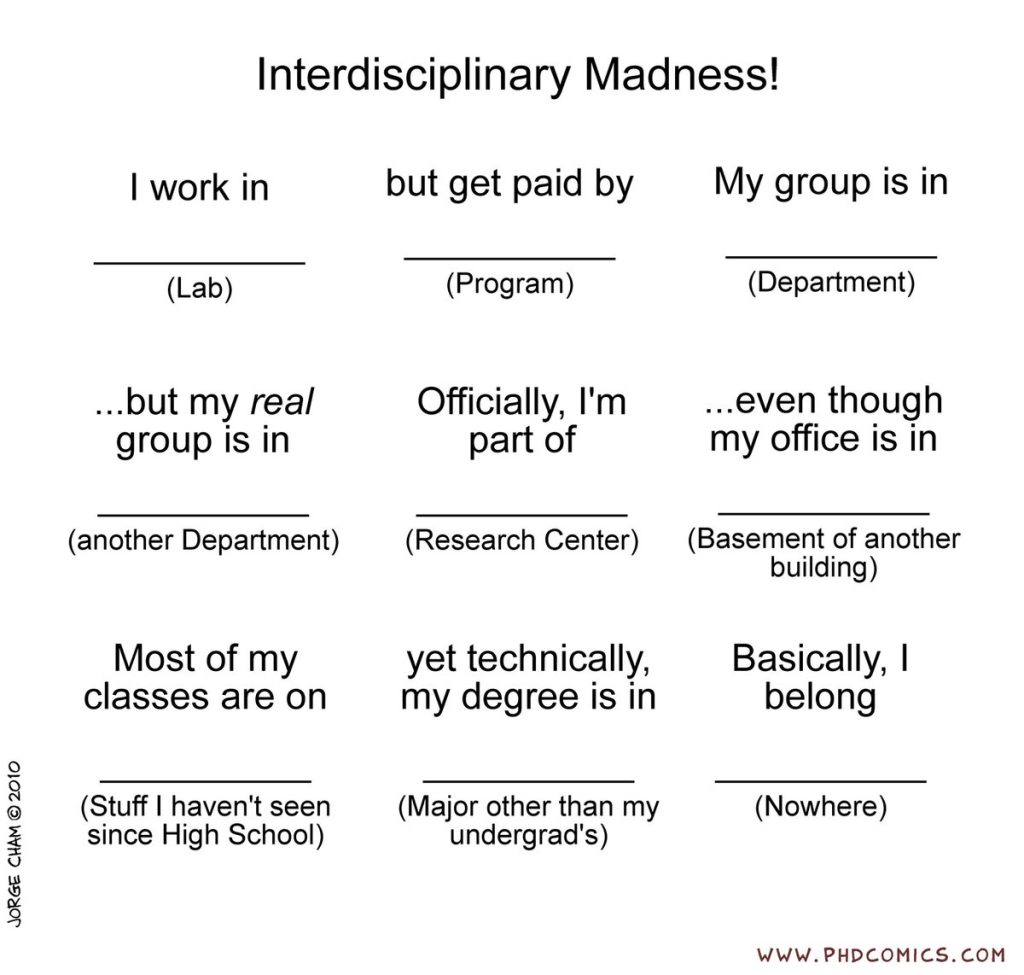
I completed my MSc and PhD through the Neuroinformatics Doctoral Training Centre at the University of Edinburgh, hosted by the Institute for Adaptive and Neural Computation in the School of Informatics. I was also part of the School’s Institute for Communicating and Collaborative Systems, now named the Institute for Language, Cognition and Computation.
My office was in the Psychology department (different School) and I was part of the Human Cognitive Neuroscience group there. My computer was supplied by Informatics – hand-delivered in a bin bag (cf. Dijkstra, “Computer science is no more about computers than astronomy is about telescopes”).
My thesis was in cognitive science and officially my degree was in Informatics, which makes sense according to how Edinburgh divides up the disciplines:
Informatics has many aspects, and encompasses a number of existing academic disciplines – Artificial Intelligence, Cognitive Science and Computer Science. Each takes part of Informatics as its natural domain. In broad terms:
-
-
- Cognitive Science concerns the study of natural systems
- Computer Science concerns the analysis of computation, and design of computing systems
- Artificial Intelligence plays a connecting role, designing systems which emulate those found in nature
-
The psychologists would have located my research somewhere between individual differences psychology and cognitive psychology. A Psychology department administrator once declared in the staff room, “I thought you were a psychologist, but you’re not.”
This is what interdisciplinary means.