Kremlin meddling

Currently in the news (11 Oct 2026):

“Andy Burnham has said Russia ‘clearly’ interfered in the 2016 Brexit referendum […]. The comments, made during an appearance on the Rest is Politics podcast, are thought to be the first time a PM has confirmed meddling by the Kremlin […].”

Jeremy Wright (24 Oct 2018), then Secretary of State for Digital, Culture, Media and Sport, when asked whether Russia has interfered in UK elections:

“What is undoubtedly true is that there have been efforts by Russia to interfere in the process. […] We cannot, at the moment, say that there is evidence that it has been successful, although I accept that it is difficult to know exactly what people have read and what they have been influenced by.”

A sample from the DCMS Disinformation and ‘fake news’ final report (14 Feb 2019):

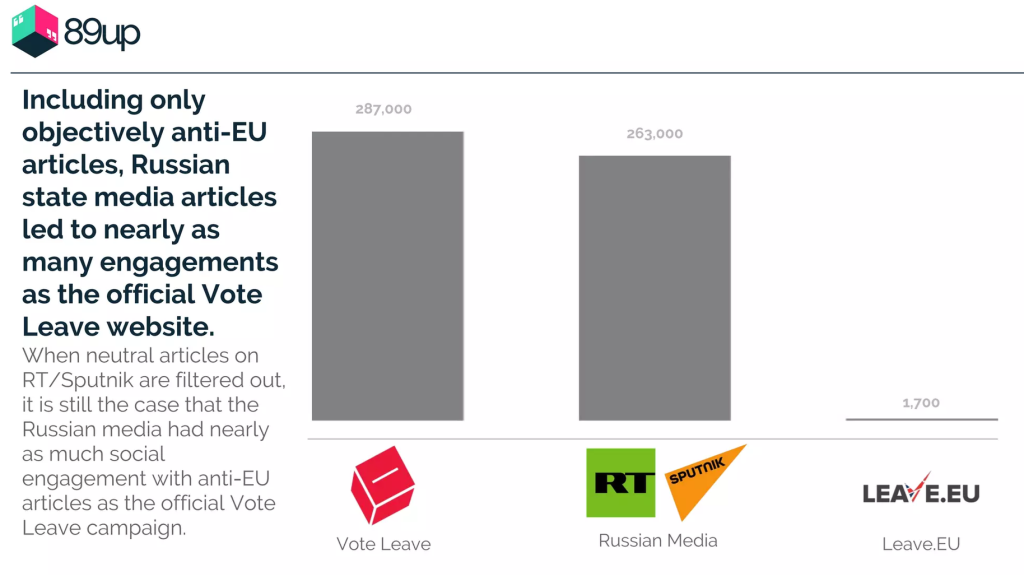
“Kremlin-aligned media published significant numbers of unique articles about the EU referendum. 89 Up researchers analysed the most shared of the articles, and identified 261 with a clear anti-EU bias to the reporting. The two main outlets were RT and Sputnik, with video produced by Ruptly.”

Here’s a key slide in the 89 Up report it cites:
Public Order Bill

If you are interested in the UK remaining a democracy then it is essential that you learn about the Public Order Bill, which is currently (early June 2022) at committee stage. Here’s Adam Wagner (Barrister, Doughty Street Chambers) – bold emphasis added:

“In this country, our tradition is that protest is something that is permitted. It is not seen as a social evil; it is seen as a social good. A certain level of disruption is inevitable in any successful protest. That is how you get people’s attention: you disrupt, and you put yourself in front of them. That is not a new thing; it is very old. It goes back to the suffragettes, who I am sure many people giving evidence will mention. Every social movement in history that has a protest element has always used an element of disruption…”

“For the most part, the mechanisms that the Bill puts in place essentially criminalise peaceful protest. That is what the Bill does: it criminalises peaceful protest in a way that has not been done before. It treats peaceful protest like knife crime, drug dealing or terrorism. I do not mean that metaphorically; I mean it directly. Serious crime disruption orders and terrorism disruption orders stop people doing something in future—those are the kinds of methods we have used to disrupt terrorism, knife crime, drug dealing and gang violence. I have been involved in lots of cases involving those kinds of orders. If the Bill is used by police—they will be under pressure to use it in particular instances—the end result will be lots more protesters in the criminal courts, in very long and complicated trials that involve looking at the proportionality of the protest in question, as we saw with the Colston statue case. But it will be 100 times more, because all these offences have a reasonable excuse […]. I think that is one thing you will see. The other thing you will see is a lot more protesters in prison—and a lot more peaceful protesters in prison.”

– Adam Wagner (Barrister, Doughty Street Chambers), evidence provided to the Public Order Bill Committee (9 June 2022)