“… the svyglm variance estimator generalises the familiar sandwich estimators to allow for non-trivial sampling.”
Thomas Lumley’s post.
Personal website – any views expressed herein are my own unless otherwise obvious
“… the svyglm variance estimator generalises the familiar sandwich estimators to allow for non-trivial sampling.”
Thomas Lumley’s post.
Take \(n\) draws from the uniform distribution on \([0, 1]\), giving \(U_1, U_2, \ldots U_n\).
Iterate \(k\) times, so you end up with a \(k \times n\) matrix.
\(\displaystyle \begin{bmatrix}
U_{1,1} & U_{1,2} & \cdots & U_{1,n} \\
U_{2,1} & U_{2,2} & \cdots & U_{2,n} \\
\vdots & \vdots & \ddots & \vdots \\
U_{k,1} & U_{k,2} & \cdots & U_{k,n}
\end{bmatrix}\)
Then average across those iterations, i.e., average each column, giving \(n\) averages. This gives you the Bates distribution, named after Grace Bates (13 August 1914 – 19 November 1996).
Here’s a picture for six success steps:
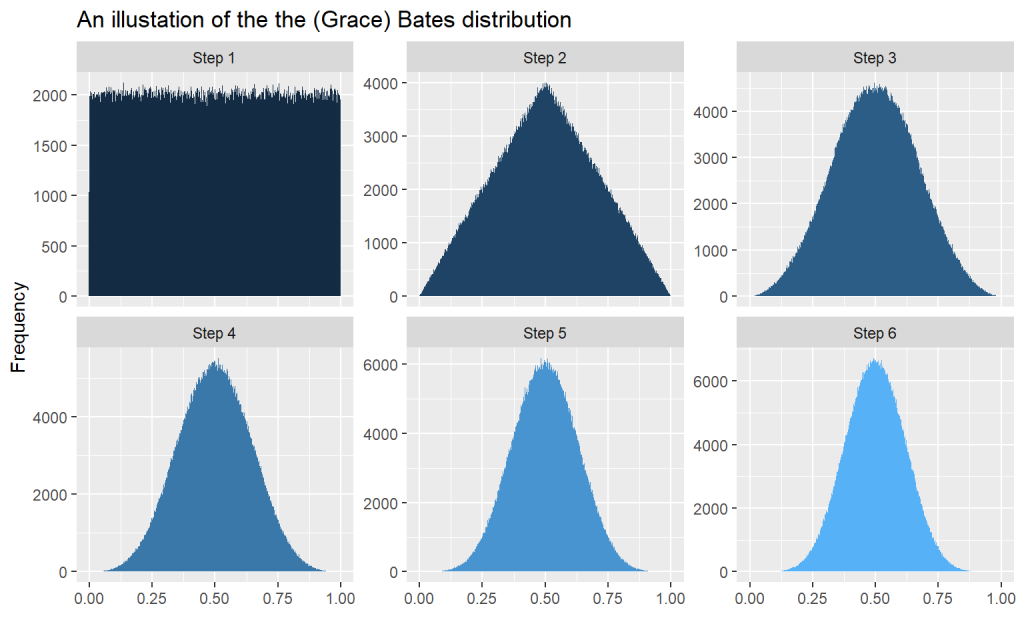
The variance of this is \(\frac{1}{12k}\), which just looks magically simple.
Suppose determinism is true. This would mean that every decision we make at any given moment follows inevitably from the laws of physics, biology, and chemistry, etc. (from here on laws of nature for short), as well as the entire chain of prior events stretching back to the beginning of the universe. Many of these laws may be neither known nor knowable. According to a widely accepted definition, free will requires the ability to have chosen otherwise. But determinism appears to rule out any possibility of having made a different choice than the one we actually did.
Philosopher Kadri Vihvelin (2004) offers a thought-provoking analysis of how free will might still be possible under determinism, a flavour of compatibilism. This post is a summary of her argument.
Before we begin, why on earth would we even entertain the idea of determinism? At first glance, the existence of randomness seems to challenge it. However, what appears random may emerge from combinations of an unimaginably vast number of deterministic causes. Pseudorandom number generators, for example, are relatively simple algorithms which produce sequences that appear random but are entirely deterministic. Algorithms are small. The universe is big. “You just won’t believe how vastly, hugely, mind-bogglingly big it is,” said Douglas Adams. The universe could be a really complicated pseudorandom generator.
Quantum mechanics also seems to challenge determinism. When measuring a quantum particle (like a photon) in superposition, the outcome follows a probability distribution (I previously tried to explain this with a toy example). This indeterminacy has led many to interpret quantum mechanics as fundamentally probabilistic. Yet some physicists defend superdeterminism, an apparently controversial idea suggesting that even quantum measurements are predetermined, including the choices physicists make when selecting measurement settings in experiments (Hossenfelder & Palmer, 2020).
That’s just a sketch; however, hopefully enough to suggest that determinism isn’t too absurd to read on.
Choosing means, more specifically, making choices on the basis of reasons. Libet and others have conducted numerous studies on the neuroscience of choosing, which may challenge the role of conscious choice (see Haggard, 2024, for discussion). However, we are more than what we are conscious of. For example, we retrieve memories without knowing how our brains searched for them, and we move through the world without being aware of how our nervous system coordinates muscle movements. I’m happy to accept a choice as mine, even if a bunch of subconscious processes did the choosing, so long as it was made on the basis of reasons – even ones I’m unaware of.
At the heart of Vihvelin’s position is the idea that our choices stem from bundles of dispositions (tendencies, causal powers, or capacities) much like the ability to speak French, drive, dance, or sing. Crucially, dispositions don’t disappear simply because we haven’t exercised them. If we chose to run at a particular moment, that doesn’t mean we lacked the disposition to walk, crawl, skip, or dance. Likewise, if we spoke French at some point, it doesn’t follow that we couldn’t have spoken English (assuming we know both languages). Or consider something simpler: a working sprinkler system. It has the dispositions required to flood a room – detecting heat or smoke (reasons) and releasing water (making a choice) – even if it never activates during its lifetime.
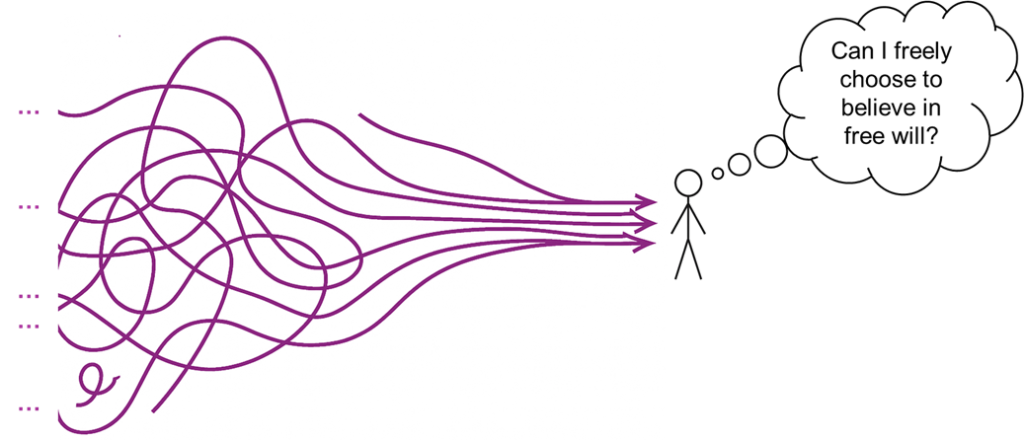
Free will, according to Vihvelin’s compatibilist account, is the ability to make choices on the basis of reasons and to have this ability is to have a bundle of dispositions. She offers the following menu of dispositions that are likely needed (p. 439):
“[T]he disposition to form and revise beliefs in response to evidence and argument; the disposition to form intentions (choose, try to act) in response to her desires […] and beliefs about how to achieve those desires; the disposition to engage in practical reasoning in response to her intention to make a rational (defensible, justifiable) decision about what to do and her belief that by engaging in practical reasoning she will succeed in making such a decision.”
So, given determinism (laws of nature, history of the universe) and a choice we made, we had a bundle of dispositions that would have enabled us to choose otherwise – free will.
Vihvelin spells out the argument as follows (p. 432):
I think that this argument also relates to what Holland (1986, p. 947) called the fundamental problem of causal inference. When evaluating a social programme, we observe the outcomes (like mental health or education) of those who take part, but we can’t observe what someone’s outcome would have been without the programme: the counterfactual outcome. We can infer their counterfactual outcomes (on average) from a well-constructed comparison group, or we can make a reasoned argument based on a theory of what they might have been able to do without the programme, including a theory of their bundles of dispositions.
It’s a similar issue with free will. When someone chooses to do something at some point in time, we can’t observe what their outcome would have been had they chosen to do differently. But, according to Vihvelin’s analysis, if they had free will, they had a bundle of dispositions that would have enabled them to choose otherwise. We can infer how they could have chosen, perhaps by finding people like them who did choose differently, or by making a counterfactual argument on the basis of what their bundle of dispositions are.
Thank you Joanna and the Philosophy Circle at NLC (14 November 2025) for helpful discussion!
Haggard, P. (2024). An intellectual history of the ‘Libet experiment’: Embedding the neuroscience of free will. Proceedings of the Paris Institute for Advanced Study, 1.
Holland, P. W. (1986). Statistics and causal inference. Journal of the American Statistical Association, 81(396), 945–960.
Hossenfelder, S., & Palmer, T. (2020). Rethinking Superdeterminism. Frontiers in Physics, 8, 139.
Vihvelin, K. (2004). Free Will Demystified: A Dispositional Account. Philosophical Topics, 32, 427–450.
Neat taxonomy of comments to draw on, from yonder.
| praise: | Praises highlight something positive. Try to leave at least one of these comments per review. Do not leave false praise (which can actually be damaging). Do look for something to sincerely praise. |
| nitpick: | Nitpicks are trivial preference-based requests. These should be non-blocking by nature. |
| suggestion: | Suggestions propose improvements to the current subject. It’s important to be explicit and clear on what is being suggested and why it is an improvement. Consider using patches and the blocking or non-blocking decorations to further communicate your intent. |
| issue: | Issues highlight specific problems with the subject under review. These problems can be user-facing or behind the scenes. It is strongly recommended to pair this comment with a suggestion. If you are not sure if a problem exists or not, consider leaving a question. |
| todo: | TODO’s are small, trivial, but necessary changes. Distinguishing todo comments from issues: or suggestions: helps direct the reader’s attention to comments requiring more involvement. |
| question: | Questions are appropriate if you have a potential concern but are not quite sure if it’s relevant or not. Asking the author for clarification or investigation can lead to a quick resolution. |
| thought: | Thoughts represent an idea that popped up from reviewing. These comments are non-blocking by nature, but they are extremely valuable and can lead to more focused initiatives and mentoring opportunities. |
| chore: | Chores are simple tasks that must be done before the subject can be “officially” accepted. Usually, these comments reference some common process. Try to leave a link to the process description so that the reader knows how to resolve the chore. |
| note: | Notes are always non-blocking and simply highlight something the reader should take note of. |
Additional options:
| typo: | Typo comments are like todo:, where the main issue is a misspelling. |
| polish: | Polish comments are like a suggestion, where there is nothing necessarily wrong with the relevant content, there’s just some ways to immediately improve the quality. |
| quibble: | Quibbles are very much like nitpick:, except it does not conjure up images of lice and animal hygiene practices. |
One of the fab things about statistics and siblings like psychometrics is that they develop ways to estimate quantities that it is impossible to measure directly, alongside the uncertainty around those estimates. Measure reliability is an example: it tells us how much of the variation in observed scores (e.g., from school exams or mental health symptom measures) is due to actual differences between people in what’s being measured, rather than random error. In classical test theory, reliability (call it \(r\)) is defined as the proportion of observed score variance that reflects true score variance:
\(\displaystyle r = \frac{\sigma^2_T}{\sigma^2_X}\),
where \(\sigma^2_T\) is the variance of the true scores (what we’d see if we could measure perfectly) and \(\sigma^2_X\) is the variance of the scores we actually observe, which includes both true variation and variance due to random error. Making that explicit:
\(\displaystyle r = \frac{\sigma^2_T}{\sigma^2_T + \sigma^2_\epsilon}\),
where \(\sigma^2_\epsilon\) is the error variance. So if \(\sigma^2_\epsilon\) were zero, the reliability would be 1.
Alas, we can’t directly observe the true scores, so we can’t calculate \(\sigma^2_T\) exactly and can’t calculate reliability. Instead, we estimate reliability using correlations between repeated measurements over time, across items, or between raters.
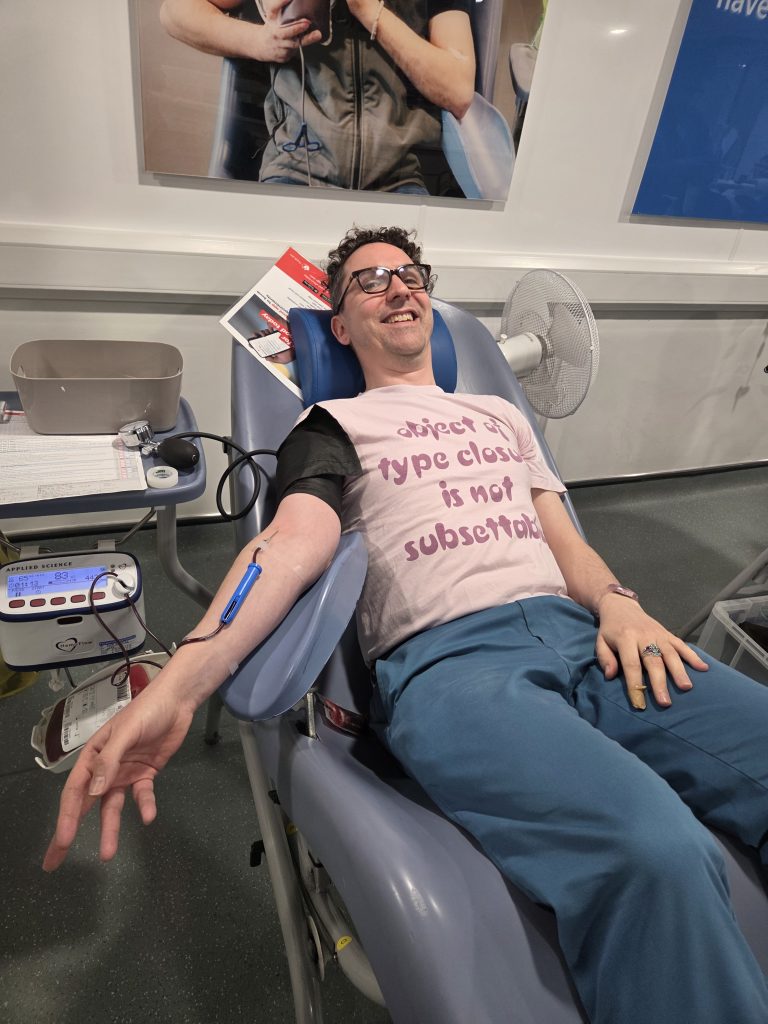
I recently donated blood for the first time – something I’ve wanted to do for years but hadn’t quite felt brave enough to try. It was much better than expected.
About a week before, I had a 15-minute phone call covering some screening questions, explaining what to expect on donation day, and thanking me for volunteering.
On arrival, I was plied with orange squash (there’s a choice of flavours). Most of the allocated hour was spent waiting, filling out a brief form, and going through a screening in a private room. A finger prick produced a little blob of blood for the iron test; it was dropped into a test tube and sank at the pace it’s supposed to – thankfully. The donation itself took about ten minutes, in a room with a few others and a telly. I was advised to clench and relax my buttocks to speed it along. Once I was done, a machine bleeped like I’d just finished a level on a 90s Game Boy game.
The process ends in a waiting area together with other volunteers. It featured more orange squash (or another soft drink of your choice) and a basket of snacks. I went for custard cremes and shortbread; I would (also) have had some sweet and salty popcorn if I hadn’t been going to the cinema in the evening.
If you’re curious or considering it yourself, you can find out more via blood.co.uk.
Any Mersenne Twister algorithm experts out there? Based on some experiments, I suspect that the longest initial run of identical values, that is all 0s or all 1s, from rbinom in R is 32. Since that’s a power of 2, I wonder whether it’s an artifact of the algorithm or implementation. Does anyone know?
Here are two seeds I found:
> set.seed(1002755089)
> rbinom(n = 40, size = 1, prob = 0.5)
 [1] 1 1 1 1 1 1 1 1 1 1 1 1 1 1 1 1 1 1 1 1 1 1 1 1 1 1 1 1 1 1 1 1 0 0 1 1 0 0 1 1

> set.seed(-1144728559)
> rbinom(n = 40, size = 1, prob = 0.5)
 [1] 0 0 0 0 0 0 0 0 0 0 0 0 0 0 0 0 0 0 0 0 0 0 0 0 0 0 0 0 0 0 0 0 1 1 0 0 1 1 0 0
Edited (9 Nov 2025) to add: one working hypothesis is that the number of initial runs is driven by the seed space (\(2^{32}\) integers) and the probability of runs over that – so constrained by probability rather than the algorithm. Jan van der Laan (@dodecadron@datasci.social) looked for runs in a long vector of rbinom draws on a fixed seed and found one length 33 further along the sequence (somewhere).
set.seed(182) > x <- rbinom(1e8, 1, 0.5)
r <- rle(x)
table(r$lengths)
Harold Wilson clarified in 1974 (HC Deb 20 December 1974 vol 883 cc711-2W):
Mr. Maxwell-Hyslop asked the Prime Minister whether he will make it the practice of his administration that when Ministers employ the word “billion” in any official speeches, documents, or answers to Parliamentary Questions, they will, to avoid confusion, only do so in its British meaning of 1 million million and not in the sense in which it is used in the United States of America, which uses the term “billion” to mean 1,000 million.
The Prime Minister: No. The word “billion” is now used internationally to mean 1,000 million and it would be confusing if British Ministers were to use it in any other sense. I accept that it could still be interpreted in this country as 1 million million and I shall ask my colleagues to ensure that, if they do use it, there should be no ambiguity as to its meaning.
(Spotted thanks to Paul Bolton and Richard Cracknell’s 2009 Commons Library Briefing.)
Nice example of social construction and maybe a speech act:
As a first approximation, speech acts are those acts that can (though need not) be performed by saying that one is doing so. On this conception, resigning, promising, asserting and asking are all speech acts, while convincing, insulting and growing six inches are not. One can, for instance, resign by saying, “I resign…”, although one can also resign from a position without describing oneself as doing so.
Not sure whether it was actually a speech act – to discuss.
If you take 30 draws from a Bernoulli distribution, e.g., to randomise people to one of two conditions, there’s a \(\frac{2}{2^{30}} = \frac{1}{2^{29}} = \frac{1}{536,870,912}\) chance that all 30 will be assigned to the same condition (all 1s or all 0s).
That’s vanishingly unlikely, but using the following seed with R’s rbinom produces 30 ones:
> set.seed(236903047)
> rbinom(30, size = 1, prob = 0.5)
[1] 1 1 1 1 1 1 1 1 1 1 1 1 1 1 1 1 1 1 1 1 1 1 1 1 1 1 1 1 1 1
The seed below produces 30 zeros:
> set.seed(627034302)
> rbinom(30, size = 1, prob = 0.5)
[1] 0 0 0 0 0 0 0 0 0 0 0 0 0 0 0 0 0 0 0 0 0 0 0 0 0 0 0 0 0 0
Unlikely but possible – even if your random numbers come from atmospheric noise or quantum measurements rather than a pseudorandom generator. If you want to rule out this outcome entirely (make the probability zero), then you don’t actually want independent Bernoulli draws. You’d need a different randomisation scheme, such as blocked randomisation.
I often see reports describing checks on random sequences after they’ve been generated, when the researchers could have saved themselves the effort by building in the kind of randomness they wanted from the start.
P.S. The longest initial runs I know about are for seed 796110494, which yields 31 zeros, and 1002755089, which yields 32 ones.