Blog 🎤

Defy them all

“These internal tyrants, whether they be in the form of public opinion or what will mother say, or brother, father, aunt, or relative of any sort; what will Mrs. Grundy, Mr. Comstock, the employer, the Board of Education say? All these busybodies, moral detectives, jailers of the human spirit, what will they say? Until woman has learned to defy them all, to stand firmly on her own ground and to insist upon her own unrestricted freedom, to listen to the voice of her nature, whether it call for life’s greatest treasure, love for a man, or her most glorious privilege, the right to give birth to a child, she cannot call herself emancipated. How many emancipated women are brave enough to acknowledge that the voice of love is calling, wildly beating against their breasts, demanding to be heard, to be satisfied.”

—Emma Goldman (1911), The Tragedy of Woman’s Emancipation

How monogamous are you in your variables?

“If you are an endocrinologist you are allowed to study a vast array of problems — sexuality, personality, growth, disease processes, etc. — in addition to the internal functioning of the endocrine system, so long as you explore the relationship between the endocrine system and those explananda. Endocrinology is monogamous in its explanatory variable — the hormone system — but promiscuous in its dependent variables. […] Oncology, in contrast, is a dependent variable discipline. As an oncologist you can study any conceivable cause of cancer — toxins, genetics, viruses, even psychological states. Oncology is monogamous in its dependent variable but promiscuous in its independent variables.”

—Erik Olin Wright, Class Counts

Find what you love

“Find what you love and let it kill you. Let it drain from you your all. Let it cling onto your back and weigh you down into eventual nothingness. Let it kill you, and let it devour your remains. For all things will kill you, both slowly and fastly, but it’s much better to be killed by a lover.” (Henry Charles Bukowski.)

What happens when you set targets – examples

Goodhart’s (1975) law states that

“Any observed statistical regularity will tend to collapse once pressure is placed upon it for control purposes.”

Here are some examples.

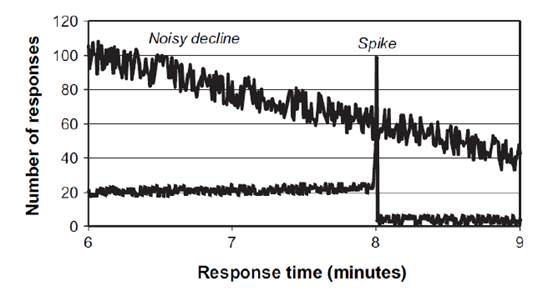
1. Ambulance response times (see Bevan and Hood, 2006)
ambulance target
Statistically unlikely spike exactly at the target suggesting something has happened to the data.

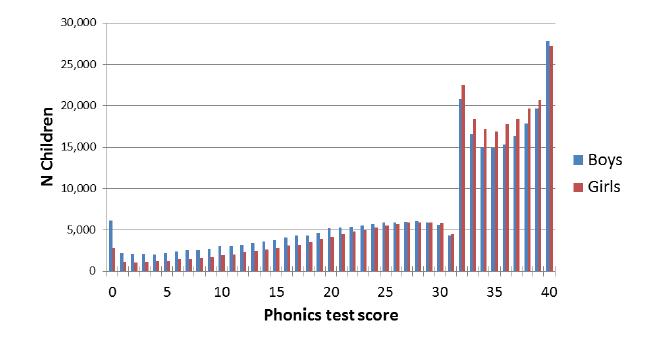
2. Phonics test scores (see Dorothy Bishop’s blog post)
phonics
A higher score is better performance. There’s a dip just below the pass mark of 32 and then a big spike, suggesting scores have been changed.

3. Call centre response times (see Caulcutt, 2004)

“The Times reported in October 2003 that the telecommunications regulator, Oftel, intended to investigate the workings of one of the newly established directory enquiry companies. According to the report: “Sixty call centre workers at the 118 118 directory enquiries service will be sacked in an attempt to head off a scandal over staff who deliberately gave out wrong numbers to boost their pay”. Why did they do this? It appears that the motivation was provided by a bonus system that rewarded employees for dealing with calls in less than 40 seconds.”

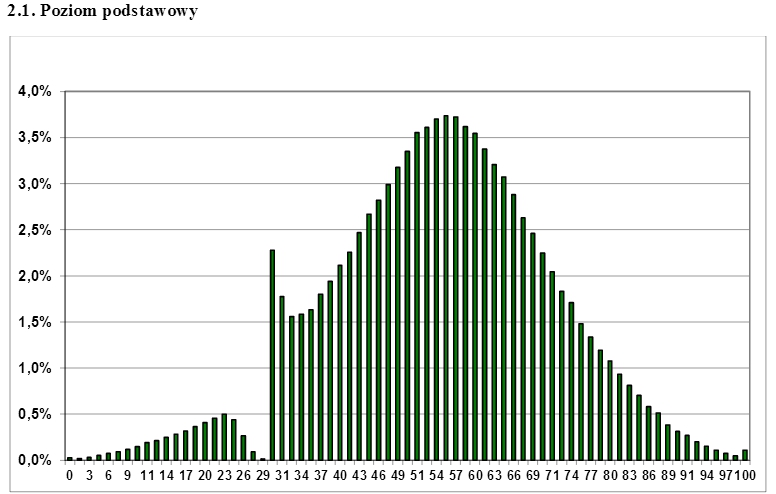
4. Final high school exam scores

Matura scores in Poland, 2013. To pass you need 30% or above.
4nnbyru(See here, spotted via @MaxCRoser.)

5. “‘G4S cheats’ made 1,000 FAKE 999 calls to boost performance figures”

“Staff at scandal-hit G4S boosted performance figures by making hundreds of fake calls to a 999 centre run by the firm.

“Five employees have been suspended after allegedly making more than 1,000 “test calls” – many reportedly at quiet times when they could be picked up quickly.

“Without them G4S would have missed key targets of answering 92% of calls within 10 seconds in November and December 2015, so incurring a financial penalty.”

(Mirror article)

References

Bevan, G., & Hood, C. (2006). What’s measured is what matters: targets and gaming in the English public health care system. Public administration, 84(3), 517-538.

Caulcutt, R. (2004). Managing by fact. Significance, 1(1), 36-38.

Goodhart, C. A. E. (1975). Monetary relationships: A view from Threadneedle Street. In Papers in Monetary Economics, Vol 1, Reserve Bank of Australia.

Those who want to study what is in front of their eyes

Wise words from Colin Mills:

“I’m seldom interested in the data in front of me for its own sake and normally want to regard it as evidence about some larger population (or process) from which it has been sampled. In saying this I am not saying that quantification is all there is to sociology. That would be absurd. Before you can count anything you have to know what you are looking for, which implies that you have to have spent some time thinking out the concepts that will organize reality and tell you what is important.”

“… the institutionalized and therefore little questioned distinction between qualitative and quantitative empirical research is, to say the least, unhelpful and should be abolished. There is a much bigger intellectual gulf between those who just want to study what is in front of their eyes and those who view what is in front of their eyes as an instantiation of something bigger. Qualitative or quantitative if your business is generalization you have to have some theory of inference and if you don’t then your intellectual project is, in my view, incoherent.”

Everyone is a genius at something

“Every normal man, woman, and child is, then, a genius at something as well as an idiot at something.

“It remains to discover what – at any rate in respect of the genius. This must be a most difficult matter, owing to the very fact that it occurs in only a minute proportion out of all possible abilities. It certainly cannot be detected by any of the testing procedures at present in current usage, but these procedures are capable, I believe, of vast improvement.

“The preceding considerations have often appealed to me on looking at a procession of the unemployed, and hearing some one whisper that they are mostly the unemployable. That they are so actually I cannot help concurring. But need they be so necessarily ? Remember that every one of these, too, is a genius at something – if we could only discover what. I cherish no illusion, indeed, that among them may be marching some ‘mute inglorious Milton, some Cromwell guiltless of his country’s blood.’ For these are walks in life that appear to involve a large amount of g. But I am quite confident that every one of them could do something that would make him a treasure in some great industrial concern; and I see no reason why some should not have even become famous, in such occupations, for example, as those of dancers, jockeys, or players of popular games.”

Spearman, C. (1925). Some Issues in the Theory of`”g”‘(including the Law of Diminishing Returns). Nature, 116, 436-439.

The role of measurement in science

“The road from scientific law to scientific measurement can rarely be traveled in the reverse direction. To discover quantitative regularity one must normally know what regularity one is seeking and one’s instruments must be designed accordingly; even then nature may not yield consistent or generalizable results without a struggle. […] I venture the following paradox: The full and intimate quantification of any science is a consummation devoutly to be wished. Nevertheless, it is not a consummation that can effectively be sought by measuring. As in individual development, so in the scientific group, maturity comes most surely to those who know how to wait.” (Kuhn, 1961, pp. 189-190)

Kuhn, T. S. (1961). The function of measurement in modern physical science. Isis, 52(2), 161-193.

Greenwood function

Just found the Greenwood function, “that describes the relationship between the frequency of a pure tone and the position of the hair cells measured as the fraction of the total length of the cochlear spiral in which it resides” – pretty cool.

R code to make the picture below:

curve(165.4*(10^(0.06*x)-1), 0.3, 35, log = "y", xlab = "mm", ylab = "Frequency", main = "Greenwood function")

greenwood


Social organisation without authority

Colin Ward (1966), Anarchism as a Theory of Organization:

“[…] ‘anarchy’ means the absence of government, the absence of authority. Can there be social organisation without authority, without government? The anarchists claim that there can be, and they also claim that it is desirable that there should be.

“Anyone can see that there are at least two kinds of organisation. There is the kind which is forced on you, the kind which is run from above, and there is the kind which is run from below, which can’t force you to do anything, and which you are free to join or free to leave alone. We could say that the anarchists are people who want to transform all kinds of human organisation into the kind of purely voluntary association where people can pull out and start one of their own if they don’t like it. I […] attempted to enunciate four principles behind an anarchist theory of organisation: that they should be

“(1) voluntary, (2) functional, (3) temporary, and (4) small.

“They should be voluntary for obvious reasons. There is no point in our advocating individual freedom and responsibility if we are going to advocate organisations for which membership is mandatory.

“They should be functional and temporary precisely because permanence is one of those factors which harden the arteries of an organisation, giving it a vested interest in its own survival, in serving the interests of office-holders rather than its function.

“They should be small precisely because in small face-to-face groups, the bureaucratising and hierarchical tendencies inherent in organisations have least opportunity to develop.”

“I abandoned psychoanalysis. But I am a psychoanalyst”

MaraSelviniPalazzoli

“I am in a certain way a psychoanalyst – I am still a psychoanalyst from a certain point of view. From another point of view, I am not a psychoanalyst, because I refuse in my work with the family to use the psychoanalytic model. The psychoanalytic model was developed by Freud in the last century and Freud could not know the systemic way of thinking. Also, in my opinion, it is not true that the psychoanalytic model is only intrapsychic. A certain part of psychoanalysis is intrapsychic. For example, what Freud calls the parts of the psyche-the ego, superego, and id-are intrapsychic because they describe the way in which the psyche, the mind of a person, functions. But in therapy, the psychoanalytic model is not intrapsychic; rather, it is dyadic when it is correct, because it is in analysis that the relationship between the therapist and the patient, the transference, is analyzed. So Freud‘s ego, superego and id and so on are intrapsychic. Freud’s transference is dyadic.

“[…] Dyadic thinking is not enough, because the family is at least a triad. It is necessary to remember that a system is not the sum of dyads or the sum of individuals-mother and father, son and mother, father and son, son and daughter, daughter and mother. It is necessary to observe all systems functioning at the same moment. So psychoanalysis continues in the Aristotelian way of thinking and has no way of looking at other concepts, such as coalition of two people against a third person and so on; it remains an intrapsychic or dyadic model. It is necessary to go beyond even the triad.”

“[…] according to the model, I abandoned psychoanalysis. But I am a psychoanalyst according to the rigorous study of continuity which my psychoanalytic mentors taught me.”

References

Barrows, S. E. (1982). Interview with Mara Selvini Palazzoli and Giuliana Prata. American Journal of Family Therapy, 10(3), 60-69.